Thieves choose the easiest car on the street. Make sure it isn't yours.
A visible, Sold Secure-rated bar turns a 60-second theft into a noisy, tool-heavy job — so the thief moves on.
Steering wheel lock: the short version
By Stephen Hall, Data lead, Swift AssistA steering wheel lock is a hardened steel bar or full-face cover that clamps to the wheel and stops it turning far enough to drive. It works in two ways: physically, because the car cannot be steered, and visually, because a thief choosing between cars picks the one without it.
- Get this right first
- Size, and drive side. Both are commoner causes of a return than any quality issue
- How to measure
- Across the wheel, outside edge to outside edge, through the centre
- If you fall between sizes
- Go smaller, not larger. A loose fit is a defeatable fit.
- What it stops
- The drive-away, regardless of how the car was entered or started
- What it does not stop
- Entry, theft of contents, or the car being lifted onto a flatbed
- Typical price
- £45–£200 depending on type and rating
What actually happens
Most vehicle theft is a selection problem: a thief walks or drives a street — including the worst streets our police-data pages name in every town — and picks the car that offers the least resistance. Electronic attacks (relay, OBD programming) beat electronic defences silently; what they don't beat is hardened steel physically preventing the car from being steered.
The deterrent works before the attack even starts: two identical cars, one with a bright bar across the wheel, and the choice is made in seconds — against the protected car.
Background: the theft and collision patterns above draw on our own analysis of official records — explore the vehicle crime data and methodology.
How does a steering wheel lock work?
A steering wheel lock is a hardened steel bar or full-face cover that clamps to the wheel and stops it turning far enough to drive. It works in two ways: physically, because the car cannot be steered, and visually, because a thief choosing between cars picks the one without it.
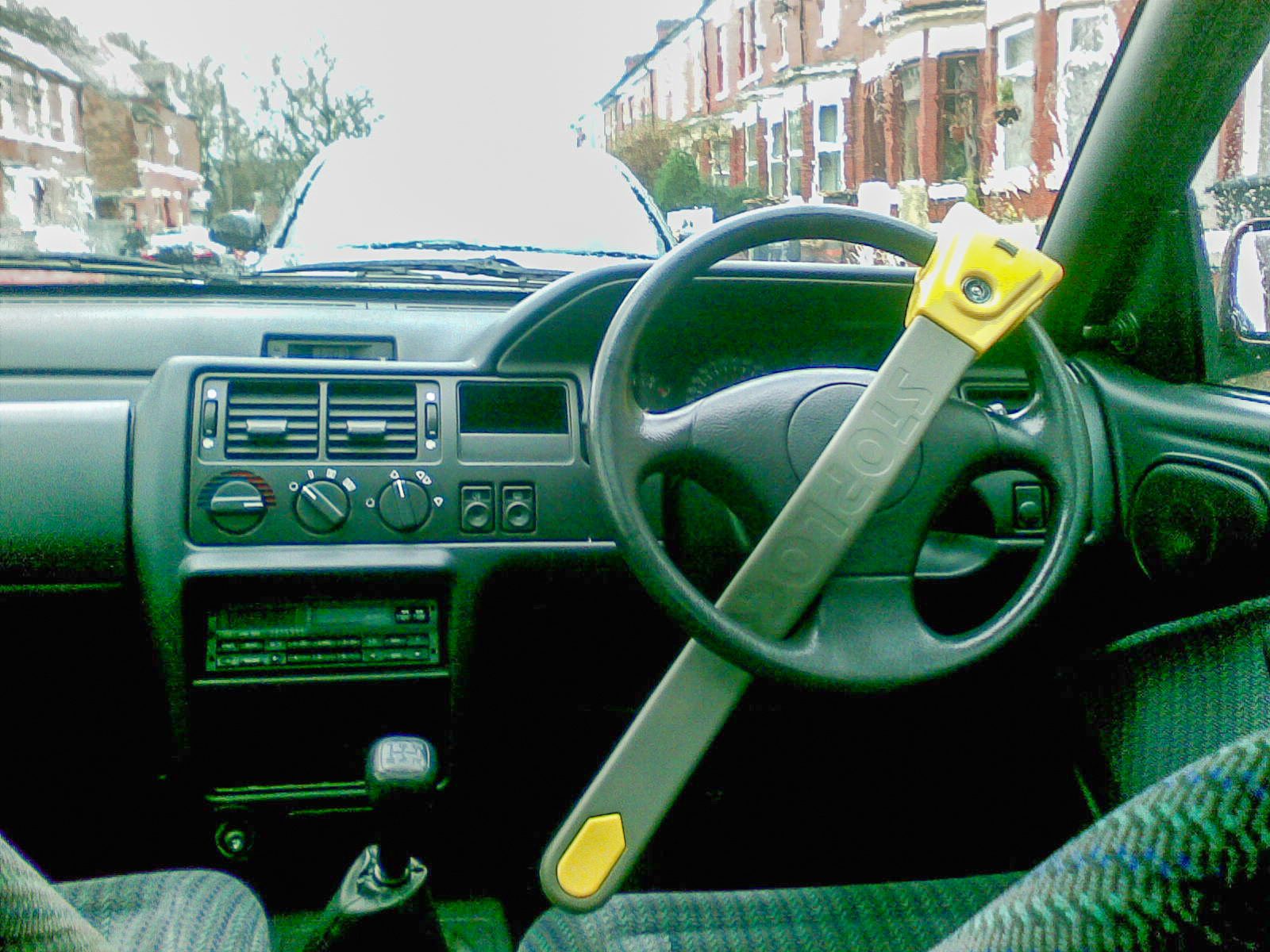
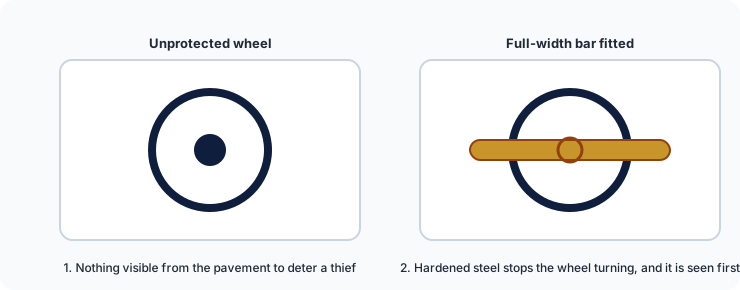
- 1Fit takes secondsA bar lock hooks over the wheel rim at two points and extends so it fouls the dashboard or door; a full-cover lock encloses the whole wheel. Both lock with a key, and both are designed to be fitted in under ten seconds so they actually get used every night.
- 2Why it stops the drive-awayElectronic theft methods — relay attacks, OBD key cloning — defeat the car's electronics silently. None of them turn a wheel that is mechanically blocked, which is why a physical lock still works against thoroughly modern attacks.
- 3The deterrent does the workMost vehicle theft is target selection: a thief walks a street and picks the easiest car. A bright bar visible through the windscreen moves your car to the bottom of that list before anyone touches it.
- 4Why the rating mattersSold Secure test locks under sustained tool attack. Diamond survives the longest, Gold below it, and unrated locks often fail to hand tools in seconds. A lock that fails quickly is worse than none, because it buys false confidence.
Four types of steering lock, compared
Bars, full-cover discs, pedal links and unrated clamps do different jobs at very different prices. Two of them are worth buying, one is situational, and one mostly sells paint.
| Type | How it works | Typical cost | Servicing | Watch out for |
|---|---|---|---|---|
| Attack-rated bar | Hardened bar across the wheel, hooks at both ends | £45–£80 | Lubricate the barrel yearly | Check it clears the airbag housing on a modern wheel |
| Full-cover disc | Encloses the entire wheel; the outer shell spins freely when attacked | £150–£200 | Keep the lock face clean | Three sizes and separate RHD/LHD versions. Heavy to stow. |
| Wheel-to-pedal bar | Links the wheel to a pedal | £25–£60 | Minimal | Awkward to fit nightly, and the pedal box is often the weaker anchor |
| Unrated budget clamp | Light alloy or thin steel | Under £25 | n/a | Bends or picks in seconds. Buys visible deterrence and very little else. |
How to install one
- 1Measure the wheel before you orderOutside edge to outside edge, straight through the centre, in centimetres. Manufacturers change wheel diameters between model years, so measure the actual car rather than trusting a year-based lookup.
- 2Check the drive sideFull-cover locks are sold in separate right-hand-drive and left-hand-drive versions. The LHD version will not sit correctly on a UK car. This is easy to get wrong on a marketplace listing where the title does not say.
- 3Check airbag clearanceSome designs sit hard against the centre boss. A deeper profile is made specifically to clear the airbag housing on modern wheels; a shallow one may not.
- 4Fit it once in daylightPractise before the first cold, wet night. A lock that takes fiddling stays in the boot, and a lock in the boot protects nothing.
- 5Position it to be seenThe bright section should be visible through the windscreen from the pavement. Half the product is the deterrent, and the deterrent only works if a passer-by can see it.
What it does not do
Most pages about this product only tell you the good part. These are the objections raised by owners and locksmiths, and they are fair ones.
Given time and quiet, most physical security yields
The right question is not whether it can be defeated but how long, how loudly and how visibly. Rated locks turn a silent sixty-second theft into minutes of conspicuous work, and street thieves work to a clock.
The visible deterrent does more than the steel
Most vehicle theft is target selection. A bright bar seen through the windscreen moves your car down the list before anyone touches it — which is why a cheap visible lock frequently outperforms an expensive hidden system, an argument no retailer will make for you.
It does nothing about entry or a flatbed
Your contents are still reachable, and a wheel lock does not stop a vehicle being winched onto a truck. It stops the drive-away specifically.
Certification is a maze and the labels are often wrong
Sold Secure is the applicable independent scheme for this category and currently lists only six automotive steering wheel locks. Thatcham categories are a separate scheme, not a lower grade. Marketplace listings frequently claim ratings a product does not hold, so check the certifier's own database rather than the box.
Measure before you order
Before you order
Which size do you need?
Measure across the face of your steering wheel, outside edge to outside edge, straight through the centre. Use a tape measure on the actual car — manufacturers change wheel diameters between model years, so a lookup by registration is less reliable than thirty seconds with a tape.
Then check two more things.
Drive side. Full-cover locks are sold in separate right-hand-drive and left-hand-drive versions, and the LHD version does not sit correctly on a UK car. Marketplace listings do not always say which one you are looking at.
Airbag clearance. Modern wheels have a substantial centre boss. Some locks are made with a deeper profile specifically to clear it and some sit hard against it. If a manufacturer publishes a list of vehicles its lock does not fit, read it before ordering rather than after.
Bands shown are the common three-size pattern and are indicative. Individual manufacturers set their own ranges and occasionally revise them, so check the maker’s own chart against your measurement before you buy.
What to buy — the checklist
- ✓A current, checkable attack rating — Sold Secure Diamond or Gold, or a Thatcham category. Verify which scheme, because they are not interchangeable
- ✓The right drive side and the right size for your wheel — measure across the wheel before ordering
- ✓Full-width bar designs beat small clamp styles — visibility is half the product
- ✓Check fit for your wheel thickness, especially on airbag-heavy modern wheels
- ✓Practice fitting it — a lock that's a hassle stays in the boot; a 10-second habit protects nightly
- ✓Bright colour is a feature, not a style choice: it must be seen from the pavement
Ad — we earn commission on the links below. When you buy through them we receive a commission from the retailer, at no extra cost to you. It changes nothing about what appears here: the checklist above is written first and the links are added afterwards.
Where to start looking
Budget: attack-rated bar
Thatcham Category 3 rated (not currently in the Sold Secure database). Bright, fits most wheels, quick to fit nightly — the sensible default.
£45–£60 · See options →
Upgrade: full-cover disc
The strongest visual and physical deterrent made. Buy the RIGHT-HAND-DRIVE version and measure your wheel first — it comes in three sizes and the LHD version does not fit a UK car properly. Deliberately no direct listing link: variants are easy to get wrong.
£150–£200 · See options →
Searches, not endorsements of a single listing — compare whatever you find against the checklist above. Want named picks ranked by attack rating? Best steering wheel locks UK (2026): ranked by Sold Secure attack rating.
What changes once you own it
Your car stops being the easy option. Combined with a Faraday pouch it covers both attack routes — electronic and physical — for under £100 total, which is typically less than a third of one insurance excess. Fit takes ten seconds a night; the message it sends takes none.
Asked before buying
Can't thieves cut steering locks off?
Given time, tools and noise, most physical security yields — but that's the wrong test. Attack-rated locks take minutes of loud, conspicuous work, and street thieves operate on seconds of silence. The lock doesn't need to be uncuttable; it needs to make the car next to yours the better choice.
Which rating should I look for?
Sold Secure is the independent benchmark for this category — Diamond is the highest, Gold below it — and it currently lists only six automotive steering wheel locks. A product may instead hold a Thatcham category, which is a different scheme rather than a lower grade, so check which one a lock actually holds rather than assuming. Unrated locks can be bent or picked in seconds and mostly sell paint.
What size do I need, and does drive side matter?
Both matter more than the brand. Full-cover locks come in three sizes measured across the wheel from outside edge to outside edge, and if you fall between sizes the guidance is to go smaller rather than larger. They are also sold in separate right-hand-drive and left-hand-drive versions, and the LHD version will not sit correctly on a UK car. Measure before ordering — this is the commonest cause of returns in the category, and returning four kilos of steel is a genuine nuisance.
Is it worth it on an older car?
Often more so — older cars lack immobiliser sophistication and are stolen with basic methods a physical lock directly blocks. It's also the cheapest insurance-excess protection an older car can buy.
What size do I need?
Measure across your steering wheel, outside edge to outside edge, straight through the centre. Full-cover locks are typically sold in three size bands covering roughly 35cm to 44cm. If you fall between two sizes the guidance is to go smaller rather than larger, because a loose fit gives an attacker somewhere to lever. Manufacturers change wheel diameters between model years, so measure the actual car rather than relying on a year-based lookup.
Does it matter whether my car is right or left-hand drive?
For full-cover locks, yes, and it is easy to get wrong. They are sold in separate right-hand-drive and left-hand-drive versions, and the LHD version does not sit correctly on a UK car. Marketplace listings do not always make this clear in the title, so check the specification before ordering — this is a common and expensive mistake on a four-kilo steel object you then have to post back.
Will it clear my airbag?
Not all designs will. Modern wheels have a substantial centre boss, and some locks are made with a deeper profile specifically to clear it while others sit hard against it. Check the product's own fitting guidance against your wheel, and if a manufacturer publishes a list of vehicles its lock does not fit, read it before ordering rather than after.
Are these Thatcham approved?
Thatcham no longer assesses physical devices such as steering wheel locks, so a current 'Thatcham approved' claim on this category should be treated with care. Sold Secure is the applicable independent scheme, and it lists only a handful of automotive steering wheel locks. Some products hold an older Thatcham category, which is a different scheme rather than a lower grade. Check the certifier's own database rather than the packaging.
How this page is funded. Some links here go to Amazon, and as an Amazon Associate we earn commission from qualifying purchases, at no extra cost to you. It changes nothing about what we recommend: the checklist above is written first, the links are added afterwards, and we hold no stock of this product and take no payment for placement. Where a product does not deserve a recommendation, we say so.
Where this fits
A modern car theft is three actions in sequence. Each defence blocks one of them.
Almost every guide to car security lists products. Almost none explain that a keyless theft happens in a fixed order, that each defence interrupts one specific step, and that blocking one step does nothing about the others. That is why people buy a signal-blocking pouch, feel protected, and are still stolen from — the pouch stops the first step and the thief simply starts at the second.
- 1
How does a thief get into a locked car without breaking anything?
They relay the signal from your key through the wall of your house. One person stands near the front door with an amplifier, another at the car with a repeater, and the car believes the key is in the driver's hand. A signal-blocking pouch ends this: sealed inside, the fob cannot transmit, so there is nothing to relay.
But it only protects the key. Once a thief is inside the car by any other means — a broken window, a spare key, a door left unlocked — the pouch is irrelevant.
- 2
So how do I make sure the pouch is actually used, every night?
By removing the decision. A lined box by the front door holds every key in the house and gets used because it sits where keys already land. Same shielding, no discipline required — which matters, because the usual cause of a relay theft in a household that owns a pouch is a night the pouch was not used.
But shielding the key is still only the first step. It does nothing once a thief is inside the car by another route.
- 3
They are inside the car. How do they start it without the key?
They plug a key programmer into the diagnostic socket in the driver's footwell and write a blank fob to the vehicle. The car then starts normally, which is why so many stolen cars show no damage at all. A steel case locked over that socket removes the connection point, and the attack fails before it starts.
But a lock on the port does not stop the car being taken on a flatbed, and it does not help if the thief already has a working key.
- 4
What stops the car moving even if they defeat the electronics?
A mechanical lock across the wheel, which no electronic attack touches. It works twice over: the car cannot be steered, and — more importantly — it is visible through the windscreen before anyone approaches, which moves your car down the list on a street of easier targets.
You are reading this step
See the whole sequence on one page · We could not find a single UK page that sets out the sequence and matches a defence to each stage. Retailers sell one product at a time and have no reason to tell you it is incomplete.
Related on Swift Assist
Vehicle crime in your town
Police-recorded crime around 100+ UK town centres, updated monthly — see the risk this defends against.
Read more →Faraday key pouch / box
Relay theft is the fastest-growing way cars are stolen in Britain — and it is completely defeated by a signal-blocking pouch on your hallway table. The catch nobody mentions: pouches wear out silently, so we show you how to check yours still works.
Read more →OBD port lock
Key-cloning theft runs through your car's diagnostic port. A steel lock over it closes the route.
Read more →Need this data for your own work?
Site and junction reports from £95, next working day. Free for community groups, campaigners and journalists.