The pouch only works if everyone remembers. A box by the door works because nobody has to.
A signal-blocking box that lives where keys already land, so protection stops depending on discipline.
Faraday key box: the short version
By Stephen Hall, Data lead, Swift Assist · reviewed 2026-09-05A Faraday key box is a container lined with conductive mesh or foil that blocks radio signals. A keyless car key transmits constantly so the car can recognise it nearby, and thieves amplify that signal from outside the house to unlock and start the car. Inside a properly sealed box the key cannot transmit or receive, so there is nothing to relay.
- What it is
- A metal-lined container that blocks radio signals to and from a car key
- What it stops
- Relay theft, where a thief amplifies your key's signal from outside the house
- What it does not stop
- Theft using the diagnostic port, a spare key, or forced entry
- Typical price
- £15–£35
- Fitting
- None. It is a box.
What actually happens
Relay theft needs your key to be transmitting. It usually is, sitting on a hall table a few feet from the front door.
A pouch works, but only when it is used. It fails the night somebody comes in late, drops the keys down and goes to bed.
Households have more than one key. The spare in the kitchen drawer transmits exactly as well as the one in your pocket.
Background: the theft and collision patterns above draw on our own analysis of official records — explore the vehicle crime data and methodology.
How does a Faraday key box work?
A Faraday key box is a container lined with conductive mesh or foil that blocks radio signals. A keyless car key transmits constantly so the car can recognise it nearby, and thieves amplify that signal from outside the house to unlock and start the car. Inside a properly sealed box the key cannot transmit or receive, so there is nothing to relay.
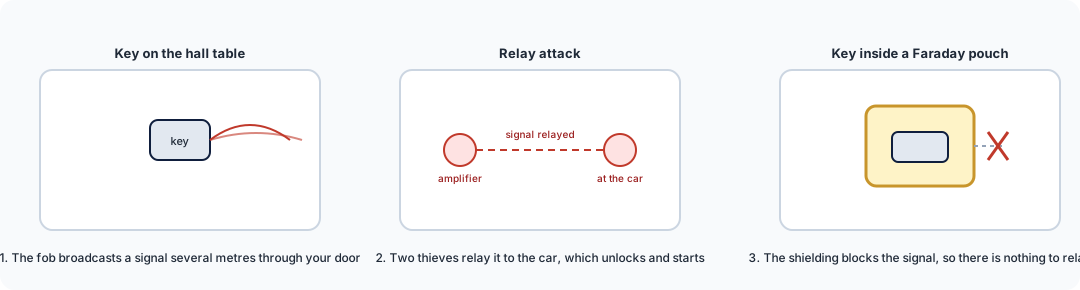
- 1The key never stops talkingA keyless fob emits a low-power signal so the car knows when you approach. On a hall table that signal is still detectable several metres away, through a door or a window. The car cannot tell the difference between you standing next to it and a relay repeating the signal.
- 2Why the box beats the pouch on consistencyBoth block the same signal. The difference is behavioural: a pouch requires a decision every time, a box requires the habit of putting keys where you already put them. The most common cause of a relay theft in a household that owns a pouch is a night when the pouch was not used.
- 3How the shielding worksThe conductive lining forms a Faraday cage. Radio waves striking it induce currents in the metal and are dissipated rather than passing through. The critical part is that the enclosure has to be complete — a gap at the lid is a hole in the cage.
- 4Prove it, then prove it againPut the key in, close the lid, stand next to the car and pull the handle. If the car stays locked, the box works. Repeat every few months. Linings fatigue and hinges distort, and a box that has stopped working looks exactly like one that still does.
Box, tin or pouch, compared
They block the same signal. What separates them is whether protection depends on somebody remembering, how many keys they hold, and whether the lid is lined as well as the base.
| Type | How it works | Typical cost | Servicing | Watch out for |
|---|---|---|---|---|
| Lined box with a hinged lid | Mesh or foil bonded to all six internal faces | £15–£35 | Test on arrival, then quarterly | Check the lid is lined, not just the base |
| Signal-blocking tin or caddy | A metal container, sometimes without a dedicated lining | £10–£20 | Test on arrival | An unlined decorative tin may not block anything. Test before trusting it. |
| Pouch | Fabric with a conductive lining, folded and sealed | £5–£15 | Test every few months | Better for travel and a single key. Depends entirely on being used. |
How to install one
- 1Put it where the keys already landBy the front door, on the shelf or table people already use. Fighting an existing habit is how a box ends up in a cupboard.
- 2Collect every key, including the sparesMain keys, second keys, the one in the drawer, the one in a coat pocket. Any key left out is the one that gets relayed.
- 3Do the handle testKey inside, lid shut, walk to the car, pull the handle. The car should stay locked. If it unlocks, the box is not sealing.
- 4Put a reminder in the calendarEvery three months, repeat the test. This is the step everybody skips and the reason a failed box goes unnoticed.
What it does not do
Most pages about this product only tell you the good part. These are the objections raised by owners and locksmiths, and they are fair ones.
It protects the key, not the car
Once a thief is inside the vehicle by any other route, a broken window or a spare key you forgot about, the box is irrelevant. That is the point at which the diagnostic port becomes the next question.
An unlined container is decoration
Some products sold as key safes are simply metal boxes. A metal box may attenuate the signal without blocking it, which is worse than useless because it feels like protection. The handle test is the only thing that settles it.
It only covers the keys inside it
The spare in the kitchen drawer transmits just as well. A box that fits every key in the house is the one that works.
What to buy — the checklist
- ✓Lined on all six faces, including the lid — a box that only shields the base leaks through the top
- ✓Large enough for every key in the house, plus the spares, or it will not get used for all of them
- ✓A lid that closes under its own weight rather than needing to be pressed shut
- ✓Heavy or grippy enough that it does not slide, so it stays where the habit is
- ✓Test it the day it arrives, and again every few months
Ad — we earn commission on the links below. When you buy through them we receive a commission from the retailer, at no extra cost to you. It changes nothing about what appears here: the checklist above is written first and the links are added afterwards.
What changes once you own it
Keys go in the box because the box is where keys already go. The relay attack stops working on your driveway, and it keeps not working on the nights when nobody was thinking about car crime.
Asked before buying
Is a Faraday box better than a pouch?
For a household, usually yes, and not because the shielding is better. Both block the same signal. The box wins because it needs no decision: keys go where keys already go. A pouch is better for travel and for a single key you carry.
Will it damage my key or drain the battery?
No. Blocking the signal does not harm the fob. If anything a key that cannot transmit uses marginally less power, though the effect is too small to notice.
How do I know it is working?
Put the key in, close it, stand next to the car and pull the door handle. If the car unlocks, the box is not blocking the signal. This is the only reliable test and it takes ten seconds.
Do I still need one if my car has motion-sensing keys?
Motion-sensing fobs go to sleep when left still, which helps overnight but does nothing for a key that has just been put down, or one that gets nudged. A box removes the variable entirely.
Does it stop the car being stolen through the diagnostic port?
No. A key box blocks the relay attack, which is how a thief gets into a locked car without damage. Once inside, a key programmer plugged into the OBD socket is a separate attack that needs a separate defence.
How this page is funded. Some links here go to Amazon, and as an Amazon Associate we earn commission from qualifying purchases, at no extra cost to you. It changes nothing about what we recommend: the checklist above is written first, the links are added afterwards, and we hold no stock of this product and take no payment for placement. Where a product does not deserve a recommendation, we say so.
Where this fits
A modern car theft is three actions in sequence. Each defence blocks one of them.
Almost every guide to car security lists products. Almost none explain that a keyless theft happens in a fixed order, that each defence interrupts one specific step, and that blocking one step does nothing about the others. That is why people buy a signal-blocking pouch, feel protected, and are still stolen from — the pouch stops the first step and the thief simply starts at the second.
- 1
How does a thief get into a locked car without breaking anything?
They relay the signal from your key through the wall of your house. One person stands near the front door with an amplifier, another at the car with a repeater, and the car believes the key is in the driver's hand. A signal-blocking pouch ends this: sealed inside, the fob cannot transmit, so there is nothing to relay.
But it only protects the key. Once a thief is inside the car by any other means — a broken window, a spare key, a door left unlocked — the pouch is irrelevant.
- 2
So how do I make sure the pouch is actually used, every night?
By removing the decision. A lined box by the front door holds every key in the house and gets used because it sits where keys already land. Same shielding, no discipline required — which matters, because the usual cause of a relay theft in a household that owns a pouch is a night the pouch was not used.
But shielding the key is still only the first step. It does nothing once a thief is inside the car by another route.
You are reading this step
- 3
They are inside the car. How do they start it without the key?
They plug a key programmer into the diagnostic socket in the driver's footwell and write a blank fob to the vehicle. The car then starts normally, which is why so many stolen cars show no damage at all. A steel case locked over that socket removes the connection point, and the attack fails before it starts.
But a lock on the port does not stop the car being taken on a flatbed, and it does not help if the thief already has a working key.
- 4
What stops the car moving even if they defeat the electronics?
A mechanical lock across the wheel, which no electronic attack touches. It works twice over: the car cannot be steered, and — more importantly — it is visible through the windscreen before anyone approaches, which moves your car down the list on a street of easier targets.
Next in the sequence: OBD port lock
But shielding the key is still only the first step. It does nothing once a thief is inside the car by another route.
See the whole sequence on one page · We could not find a single UK page that sets out the sequence and matches a defence to each stage. Retailers sell one product at a time and have no reason to tell you it is incomplete.
Related on Swift Assist
Vehicle crime in your town
Police-recorded crime around 100+ UK town centres, updated monthly — see the risk this defends against.
Read more →Faraday key pouch / box
Relay theft is the fastest-growing way cars are stolen in Britain — and it is completely defeated by a signal-blocking pouch on your hallway table. The catch nobody mentions: pouches wear out silently, so we show you how to check yours still works.
Read more →OBD port lock
Key-cloning theft runs through your car's diagnostic port. A steel lock over it closes the route.
Read more →Need this data for your own work?
Site and junction reports from £95, next working day. Free for community groups, campaigners and journalists.