Keyless car theft takes under 60 seconds. A £9 pouch ends it.
Relay theft is the fastest-growing way cars are stolen in Britain — and it is completely defeated by a signal-blocking pouch on your hallway table. The catch nobody mentions: pouches wear out silently, so we show you how to check yours still works.
In stock · on sale here shortly
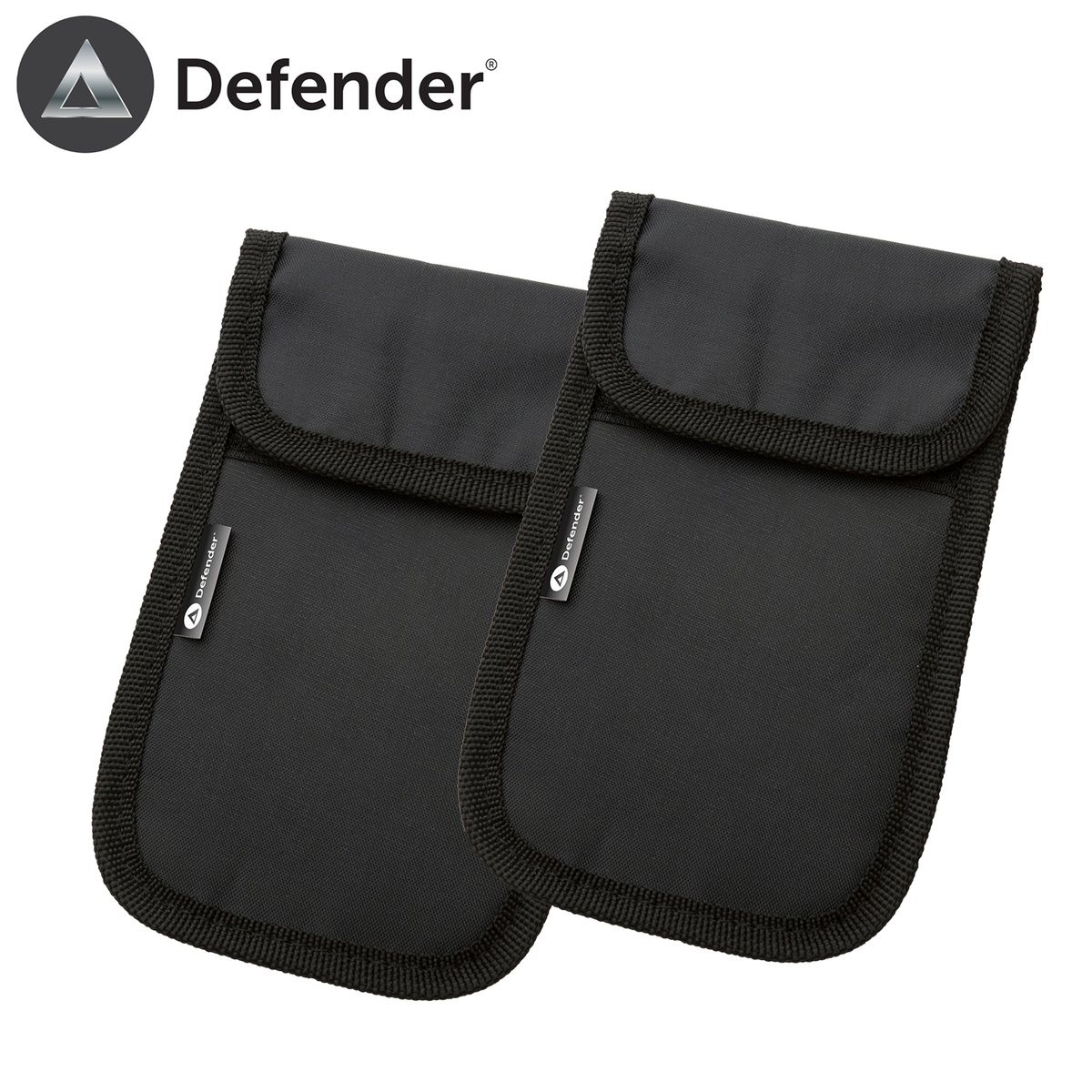
Defender Signal Blocker Faraday Pouch
Defender
Listed by Secured by Design under Police Preferred Specification. The accreditation is held by Solon Security Ltd, and the assessment route is recorded as “Specialist Assessed SBD Authorisation”. There is no numbered British Standard for Faraday pouches, so no product in this category has one.
£13.90
for 2 pouches£6.95 each, minimum order 2
Free UK delivery — Royal Mail 1st Class
Dispatched within 24 hours of your order
Tell me when it’s on saleStock is here and the price is set. We are finishing the paperwork on a change of registered office and will not take orders until that is done and published — you are entitled to know who you are buying from before you pay.
50 in stock
- 14-day returns. Change your mind for any reason, no explanation needed.
- 12-month warranty. Manufacturer’s warranty, on top of your statutory rights.
- Ships to Great Britain. See delivery and returns.
We hold this product as stock and sell it directly, so we make a margin on it. That is a reason to be sceptical of us, not to trust us — which is why the test below matters more than anything on this page, and why we tell you plainly what this pouch does not protect against.
Faraday key pouch / box: the short version
By Stephen Hall, Data lead, Swift AssistA Faraday pouch is a fabric bag lined with conductive mesh that blocks radio signals. A keyless car key transmits constantly so the car can recognise it nearby, and thieves amplify that signal from outside your house to unlock and start the car. Sealed inside the pouch the key cannot transmit or receive, so there is nothing to relay.
- First, does this apply to you?
- If you can unlock and start the car with the key in your pocket, you are exposed. If you press a button on the fob to unlock, largely not.
- What it stops
- Relay theft — amplifying your key's signal from outside the house
- What it does not stop
- Theft via the diagnostic port, a spare key, or forced entry
- Typical price
- £9 for a pouch pair, £15–£35 for a hallway box
- How to check it works
- Key inside, seal it, stand at the car, pull the handle
- How often to re-check
- Monthly. Linings fatigue before the fabric looks worn.
- Will it fit my key?
- Standard pouches take a chunky fob plus house keys. A flat key card (Renault, Tesla) fits but is heavily oversized — see the fit table below.
What actually happens
Our analysis of street-level police records counted more than 30,000 vehicle crimes around the UK town centres we track in the last 12 months — and police forces and insurers have repeatedly warned that keyless 'relay' attacks account for a large share of modern car theft: one thief stands near your front door with an amplifier, picks up your key fob's signal from inside the house, and beams it to an accomplice at the car. The car thinks the key is present, unlocks, and starts. No smashing, no forcing — often under a minute, usually at night.
The uncomfortable part: your car's convenience feature is the vulnerability. Any keyless-entry vehicle parked within signal range of its own key is exposed, every night, for as long as the key sits unprotected.
Background: the theft and collision patterns above draw on our own analysis of official records — explore the vehicle crime data and methodology.
How does a Faraday pouch work?
A Faraday pouch is a fabric bag lined with conductive mesh that blocks radio signals. A keyless car key transmits constantly so the car can recognise it nearby, and thieves amplify that signal from outside your house to unlock and start the car. Sealed inside the pouch the key cannot transmit or receive, so there is nothing to relay.
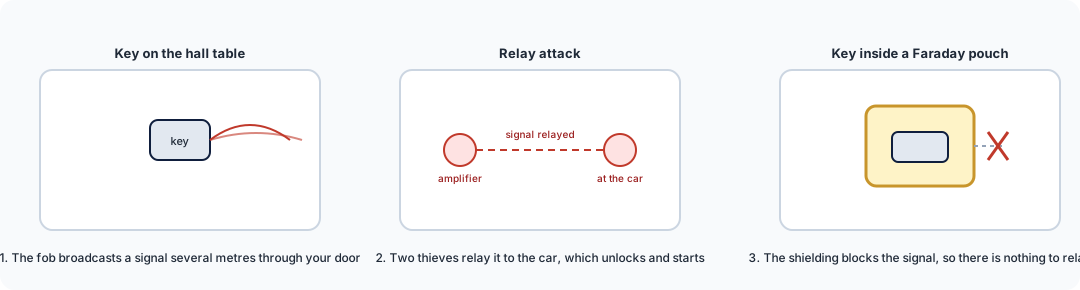
- 1First, check the attack applies to your carWalk up to your car with the key in your pocket and pull the handle without pressing anything. If it unlocks, you have keyless entry and you are exposed. If you have to press a button on the fob, the relay attack does not work on your car and a pouch is not the thing you need. This takes ten seconds and almost no page tells you to do it.
- 2The key is always talkingA keyless fob emits a low-power signal so the car knows when you approach. On a hall table that signal is still detectable several metres away, through a door or a wall. The car cannot tell the difference between you standing beside it and a relay repeating the signal from your hallway.
- 3What the lining doesThe conductive layer forms a Faraday cage. Radio waves striking it induce currents in the metal and are dissipated rather than passing through. The whole enclosure has to be complete — a pouch left half-open, or overfilled so the flap cannot close cleanly, can leak enough signal to be relayed.
- 4Prove it, then prove it againKey in, sealed, stand next to the car, pull the handle. If the car stays locked, the pouch works. For a car with keyless start but button unlock, sit inside with the key pouched and press the start button — it should refuse. Repeat every few months, because linings fatigue with daily folding long before the fabric looks worn, and a failed pouch looks identical to a working one.
What you actually get
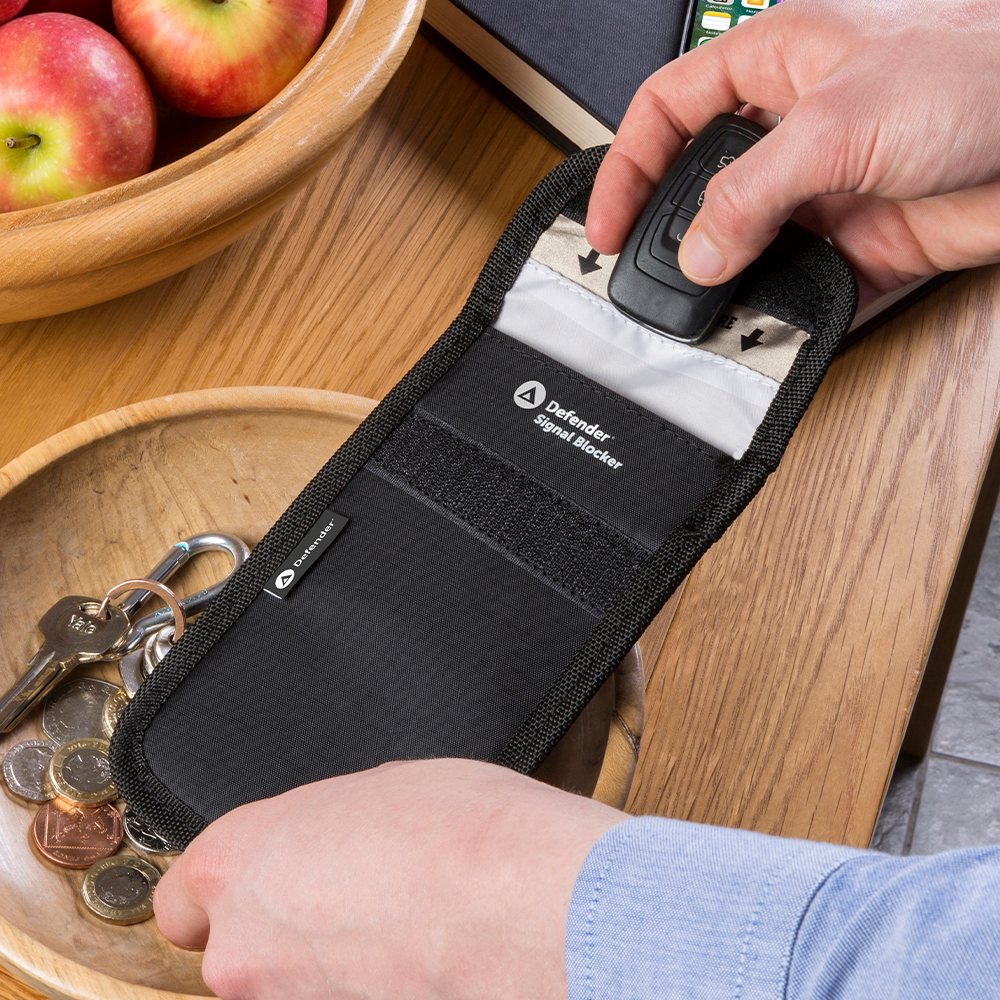
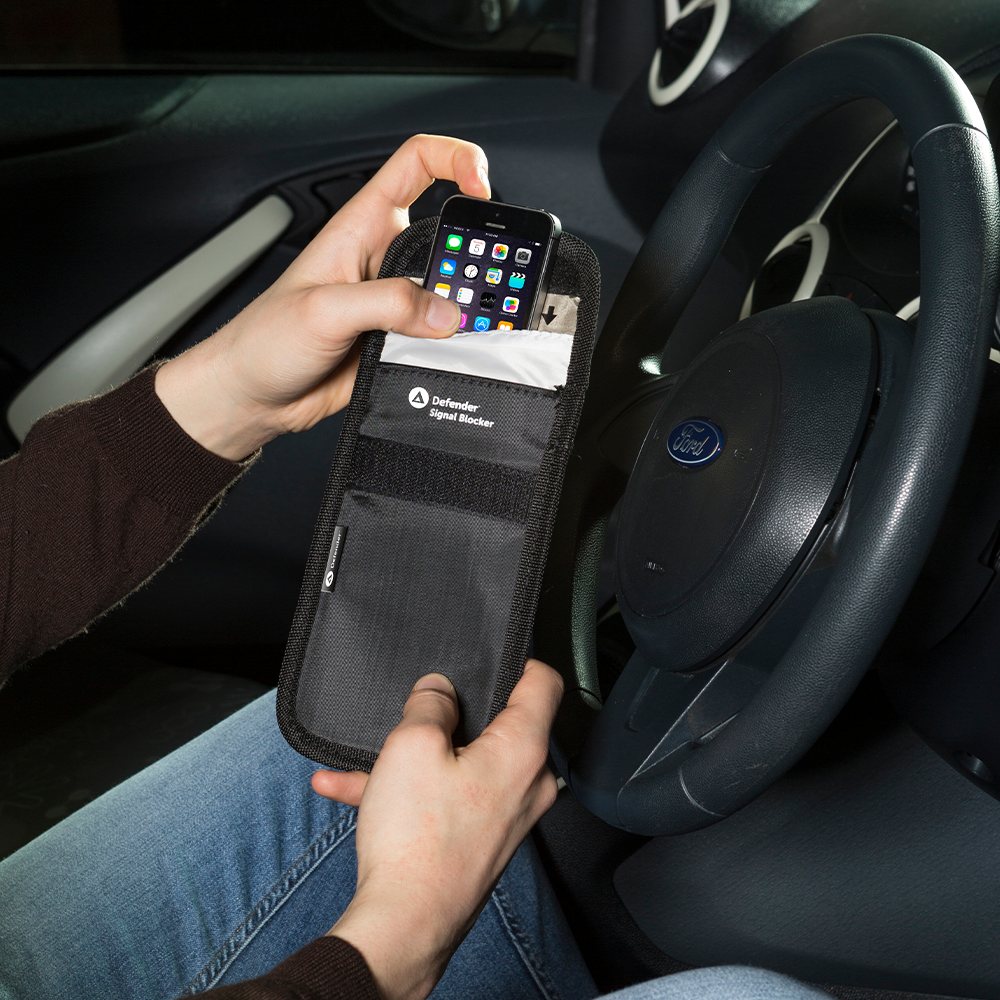
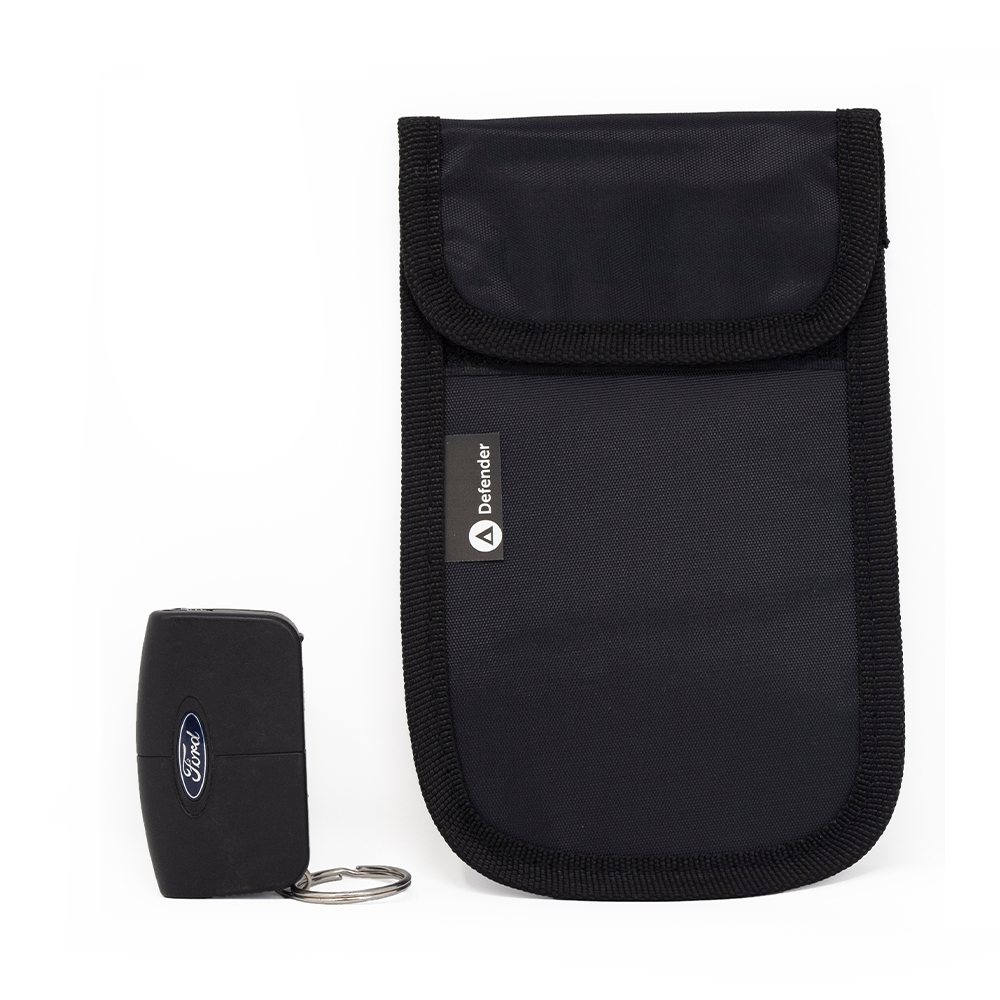
Product photographs supplied by Defender Ltd via Solon Security Ltd and used with their permission.
Will it actually fit your key?
A standard pouch measures 18.6 × 11.5 cm on the outside, but the usable space inside is smaller because the flap has to fold over cleanly to seal. That gap between the printed size and the real capacity is where most disappointment comes from — and an overfilled pouch that will not close is not a pouch, it is a bag.
| What you carry | Fits? | What to know |
|---|---|---|
| Chunky SUV or prestige fob (BMW, Range Rover, Mercedes) | Yes | The size this is designed around. Room to spare. |
| Standard blade-and-fob (Ford, VW, Toyota, Vauxhall) | Yes | Fits with space for a couple of house keys alongside. |
| Fob plus a full house keyring | Yes | This is the realistic everyday case and it is why the standard size beats the mini. |
| Flat key card (Renault, Tesla, some Peugeot) | Tight | Blocks fine, but it is a card in a pouch built for a fob — heavily oversized and easy to lose inside. A mini pouch suits it better. |
| Phone up to about 16.5 × 8 cm | Yes | Fits, which is the second reason people buy these — a phone that cannot ring is a phone that cannot distract you while driving. |
| Large phone in a thick protective case | Tight | A Galaxy S-series Plus in a rugged case only just goes in. If the flap will not fold flat, it will not seal, and a pouch that does not seal does nothing. |
| Two chunky fobs at once | No | Do not do this. Use one pouch per key — which is why the minimum order is two. |
If yours is borderline, put the key in and try to fold the flap fully closed. If it will not sit flat, use the second pouch for the second key rather than forcing both into one.
Pouch, box or biscuit tin: what actually blocks the signal
All four are sold as solutions to the same problem and they are not equivalent. The difference is less about shielding than about whether the thing gets used every night, and whether you can tell when it has stopped working.
| Type | How it works | Typical cost | Servicing | Watch out for |
|---|---|---|---|---|
| Pouch, single or twin pack | Fabric with a conductive lining, folded and sealed | £8–£15 | Test on arrival, then every few months | Depends entirely on being used. Replace yearly with daily use. |
| Lined box for the hallway | Mesh or foil bonded to all six internal faces | £15–£35 | Test on arrival, then quarterly | Check the lid is lined, not just the base. Do not wall-mount it by the front door — it advertises where the keys are. |
| Signal-blocking tin or caddy | A metal container, sometimes with no dedicated lining | £10–£20 | Test before trusting it | An unlined decorative tin may attenuate without blocking, which is worse than nothing because it feels like protection. |
| Biscuit tin or microwave | Improvised | Free | Test every time | Sometimes works, often does not, and you will not know which. Not a plan. |
How to install one
- 1Run the ten-second eligibility test firstKey in pocket, walk to the car, pull the handle without pressing anything. If nothing happens, you do not have keyless entry and you do not need this.
- 2Collect every key in the houseMain key, second key, the one in the kitchen drawer, the one in a coat pocket. Any fob left out is the one that gets relayed, and the spare is the commonest miss.
- 3Do not overfill itA pouch stuffed with two bulky fobs and a house key may not close cleanly. The seal is the product; the fabric is just fabric.
- 4Run the handle testKey sealed inside, stand next to the car, pull the handle. It must stay locked. If it opens, the pouch is not sealing and no amount of careful folding will fix it.
- 5Put a monthly reminder in your phoneOn the first of every month, repeat the handle test. It takes thirty seconds. This is the step everyone skips, and it is why a dead pouch goes unnoticed for a year — buyers on the manufacturer's own site report pouches failing at one month, six weeks and four months without noticing until they happened to check.
What it does not do
Most pages about this product only tell you the good part. These are the objections raised by owners and locksmiths, and they are fair ones.
It protects the key, not the car
Once a thief is inside by another route — a broken window, a spare key, a door left unlocked — the pouch is irrelevant. That is the point at which the diagnostic port becomes the next question.
Counterfeits are a real problem
Fleet News has reported fake pouches circulating that offer little more than reassurance. This is precisely why the handle test matters more than the brand or the price.
Only the keys inside it are protected
The spare in the drawer transmits exactly as well as the one you carry.
Motion-sensor fobs help but do not close the gap
Many modern fobs sleep when left still, and the delay before they do varies by manufacturer from under a minute to fifteen. A key that has just been put down, or one that gets nudged, is awake.
What to buy — the checklist
- ✓Dual-layer shielding fabric — single-layer pouches weaken with use
- ✓Test it the day it arrives: key inside, stand beside the car, pull the handle — the door must not open
- ✓A box for the hallway plus a pouch for your pocket covers both halves of the day
- ✓Room for both vehicles' keys — relay thieves don't care which car they take
- ✓Replace yearly if used daily — the lining fatigues before the fabric looks worn
Ad — we earn commission on the links below. When you buy through them we receive a commission from the retailer, at no extra cost to you. It changes nothing about what appears here: the checklist above is written first and the links are added afterwards.
Where to start looking
Hallway box, single car
A box by the door becomes the household habit, which is what actually protects you. Check the lid is lined, not just the base.
~£15–£25 · See options →
Multi-key household box
Big enough for every key in the house — both cars and the spares. The spare is the commonest miss.
~£15–£30 · See options →
Searches, not endorsements of a single listing — compare whatever you find against the checklist above. Want named picks ranked by attack rating? Best Faraday pouches & boxes for car keys UK (2026): what actually blocks relay theft.
What changes once you own it
The relay method — the leading route into keyless cars — simply stops working on your driveway. Your car can no longer be unlocked from your hallway, your insurance record stays intact, and you skip the average weeks-long insurance ordeal a theft claim involves. It is the highest protection-per-pound purchase in car security.
Asked before buying
Do Faraday pouches actually work?
Yes — a functioning Faraday pouch blocks the radio signal entirely, and you can verify it yourself in ten seconds: put the key in, stand next to the car, and try the handle. If the door stays locked, the relay route is dead. Test on arrival and every few months.
Do I need one if my car has a motion-sensor key?
Motion-sensor fobs that sleep when still reduce the window but don't close it — the key wakes whenever it moves, and many sleep modes take minutes to engage. A pouch costs less than a tank of fuel and closes the gap completely.
Pouch or box?
Both, ideally, and for different reasons. A box by the door becomes the household habit — keys live in the box — which matters because the usual cause of a relay theft in a home that owns a pouch is a night the pouch was not used. A pouch travels with you, and car parks and gyms are relay territory too.
How do I know if my car is even keyless?
Walk up to it with the key in your pocket and pull the door handle without pressing anything. If it unlocks, you have keyless entry and the relay attack applies to you. If you have to press a button on the fob to unlock, it largely does not, and a pouch is not the purchase you need. Some cars have button-unlock but keyless start, in which case test by sitting inside with the key pouched and pressing the start button.
Will a pouch drain my key fob battery?
No. The pouch is passive and blocking the signal does not harm the fob. What does drain a fob is being left close to the car, where it is repeatedly polled and keeps waking up — which is an argument for keeping keys away from the driveway, not against the pouch.
Won't a biscuit tin or the microwave do the same job?
Sometimes, and you will not know when it stops. Improvised containers vary enormously and a partial block is worse than none because it feels like protection. If you are going to improvise, run the handle test every single time, which is more effort than the £10 the pouch costs.
How do I know when it has stopped working?
You will not, unless you test it. That is the whole problem. Linings fatigue with daily folding long before the fabric looks worn, and a failed pouch is visually identical to a working one. Buyers on the manufacturer's own site describe exactly this — pouches that worked on arrival and had silently stopped by one month, six weeks or four months, discovered only when the car opened with the key still sealed inside. Test on arrival, then on the first of every month.
Are the cheap ones on Amazon fake?
Some are. Fleet News has reported counterfeit pouches on the UK market offering little more than reassurance. Price is a weak signal either way, which is why we point you at the test rather than a brand: a £6 pouch that passes the handle test is doing its job and a £25 one that fails is not.
Does it stop my car being stolen through the diagnostic port?
No. A pouch blocks the relay attack, which is how a thief gets into a locked car without damage. Once they are inside, a key programmer plugged into the OBD socket is a separate attack needing a separate defence.
How this page is funded. Two ways, and they are different. We buy the Defender pouch as stock and sell it directly, so we make a margin on every one sold. Other links on this page go to Amazon, where we earn commission from qualifying purchases at no extra cost to you. We take no payment for placement in either case, the checklist above is written before any link is added, and where a product does not deserve a recommendation we say so — including where the honest answer is that you do not need this product at all.
Where this fits
A modern car theft is three actions in sequence. Each defence blocks one of them.
Almost every guide to car security lists products. Almost none explain that a keyless theft happens in a fixed order, that each defence interrupts one specific step, and that blocking one step does nothing about the others. That is why people buy a signal-blocking pouch, feel protected, and are still stolen from — the pouch stops the first step and the thief simply starts at the second.
- 1
How does a thief get into a locked car without breaking anything?
They relay the signal from your key through the wall of your house. One person stands near the front door with an amplifier, another at the car with a repeater, and the car believes the key is in the driver's hand. A signal-blocking pouch ends this: sealed inside, the fob cannot transmit, so there is nothing to relay.
But it only protects the key. Once a thief is inside the car by any other means — a broken window, a spare key, a door left unlocked — the pouch is irrelevant.
You are reading this step
- 2
So how do I make sure the pouch is actually used, every night?
By removing the decision. A lined box by the front door holds every key in the house and gets used because it sits where keys already land. Same shielding, no discipline required — which matters, because the usual cause of a relay theft in a household that owns a pouch is a night the pouch was not used.
But shielding the key is still only the first step. It does nothing once a thief is inside the car by another route.
- 3
They are inside the car. How do they start it without the key?
They plug a key programmer into the diagnostic socket in the driver's footwell and write a blank fob to the vehicle. The car then starts normally, which is why so many stolen cars show no damage at all. A steel case locked over that socket removes the connection point, and the attack fails before it starts.
But a lock on the port does not stop the car being taken on a flatbed, and it does not help if the thief already has a working key.
- 4
What stops the car moving even if they defeat the electronics?
A mechanical lock across the wheel, which no electronic attack touches. It works twice over: the car cannot be steered, and — more importantly — it is visible through the windscreen before anyone approaches, which moves your car down the list on a street of easier targets.
Next in the sequence: Faraday key box
But it only protects the key. Once a thief is inside the car by any other means — a broken window, a spare key, a door left unlocked — the pouch is irrelevant.
See the whole sequence on one page · We could not find a single UK page that sets out the sequence and matches a defence to each stage. Retailers sell one product at a time and have no reason to tell you it is incomplete.
Related on Swift Assist
Vehicle crime in your town
Police-recorded crime around 100+ UK town centres, updated monthly — see the risk this defends against.
Read more →Steering wheel lock
A visible, Sold Secure-rated bar turns a 60-second theft into a noisy, tool-heavy job — so the thief moves on.
Read more →OBD port lock
Key-cloning theft runs through your car's diagnostic port. A steel lock over it closes the route.
Read more →Need this data for your own work?
Site and junction reports from £95, next working day. Free for community groups, campaigners and journalists.