Thieves can program a blank key to your car in minutes. This blocks the socket they use.
Key-cloning theft runs through your car's diagnostic port. A steel lock over it closes the route.
OBD port lock: the short version
By Stephen Hall, Data lead, Swift Assist · reviewed September 2026An OBD port lock is a hardened steel case that fits over your car's diagnostic socket and locks with a key. Thieves steal modern cars by plugging a programmer into that socket and writing a blank key to the vehicle. With the socket physically enclosed, the tool cannot be connected, so the attack fails before it starts.
- What it is
- A lock that physically or electronically blocks access to your car's OBD-II diagnostic socket
- What it stops
- Key cloning: thieves plugging a programmer into the port to register a blank key
- What it does not stop
- Break-ins, relay unlocking, towing or theft of contents
- Typical cost
- £20–£35 for a physical case; £60–£200 fitted for an electronic version
- Fitting time
- Five to ten minutes, no wiring, for a physical case
- Where the port is
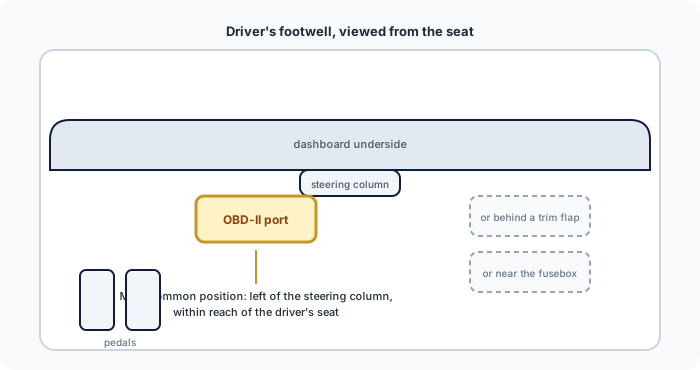
- Driver's footwell, usually left of the steering column, by law within reach of the driver
- Effect on MOT or servicing
- None. Unlock it for diagnostic access, like a locking wheel-nut key
- Best paired with
- A Faraday pouch (blocks the unlock) and a visible steering lock (blocks the drive)
What actually happens
Once inside a car — via a relay unlock or a quiet window attack — thieves plug a programmer into the OBD diagnostic socket under the dashboard and teach the car a blank key. From there, they drive away in a car that believes its owner is at the wheel. It's the second pillar of modern car theft alongside relay attacks, and it particularly affects popular models whose programmers circulate cheaply.
Manufacturers can't remove the port — it's legally required for servicing — so the defence has to be physical.
Background: the theft and collision patterns above draw on our own analysis of official records — explore the vehicle crime data and methodology.
How does an OBD port lock work?
An OBD port lock is a hardened steel case that fits over your car's diagnostic socket and locks with a key. Thieves steal modern cars by plugging a programmer into that socket and writing a blank key to the vehicle. With the socket physically enclosed, the tool cannot be connected, so the attack fails before it starts.
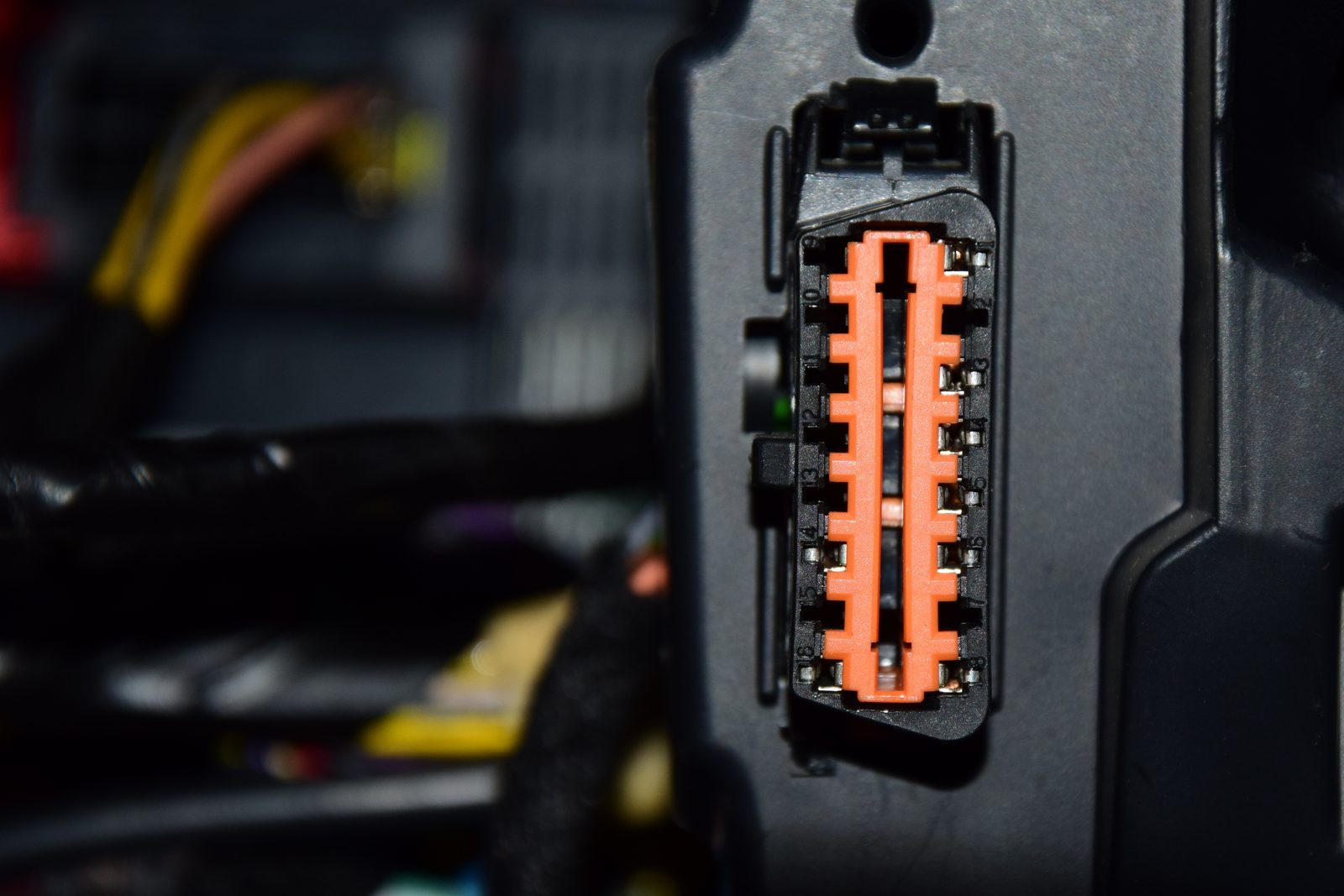
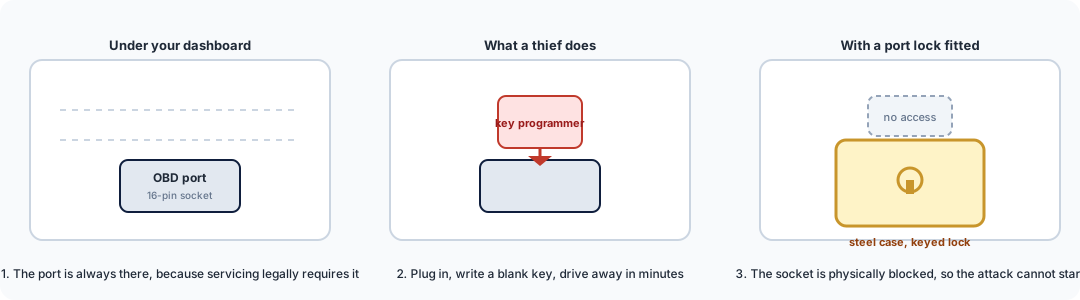
- 1Find the socketPetrol cars sold new in the EU from 2001, and diesels from 2003, must carry a 16-pin OBD-II socket (the EU calls it EOBD; the US requirement dates from 1996). It is almost always in the driver's footwell within reach of the steering column, and it exists for emissions testing and servicing, so manufacturers cannot simply delete it.
- 2Understand the attackOnce inside the car — often after a relay unlock or a quiet window break — a thief plugs a key programmer into that socket. The programmer talks to the immobiliser and registers a blank fob as a legitimate key. The car then starts normally and drives away, which is why so many stolen cars show no forced-entry damage.
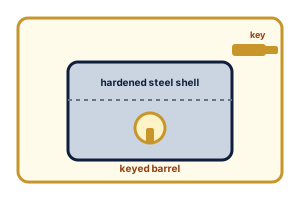
- 3How the lock blocks itThe lock is a two-part steel shell that closes around the socket and its wiring, secured with a keyed barrel or a shear bolt. There is no plug-shaped gap left to connect to, and the case resists being levered off in the dark footwell where a thief has no room to swing tools.
- 4Fitting and servicingMost fit in a few minutes with no wiring changes: the case clamps around the port or bolts to the bracket behind it. When your garage needs diagnostic access you unlock it, exactly like handing over a locking wheel-nut key. Keep the key with your service book rather than in the glovebox.
Fitting one, start to finish
A fifteen-minute walkthrough of fitting a physical port lock, including the clearance checks worth doing before you buy.
Video by ThingsMen on YouTube. We have no connection to the channel and earn nothing from it — it is here because it shows the job clearly.
Four ways to lock an OBD port, compared
They are not the same product. Physical cases block the socket, electronic versions cut the data line, relocation hides it, and blanking plates mostly buy confidence. What follows is what each actually does and where each falls down.
| Type | How it works | Typical cost | Servicing | Watch out for |
|---|---|---|---|---|
| Physical port case | A hardened steel shell closes around the socket and locks with a key or shear bolt, leaving no plug-shaped opening. | £20–£50 | Unlock it for the garage, like a locking wheel-nut key. | Check clearance: some footwells are tight, and a bulky case can foul the bonnet release or your knee. |
| Electronic (immobiliser-linked) lock | Wired in-line, it cuts the data connection between the OBD socket and the car's ECU whenever the ignition is off, so a programmer plugged in receives nothing. | £60–£200 fitted | Diagnostics work normally once the ignition is on and the system disarmed. | Needs professional fitting on most cars, and a poor install can throw fault codes or draw current. |
| Port relocation | An extension lead moves the socket to a hidden position, leaving a dummy or empty bracket where a thief expects to find it. | £30–£80 fitted | You must tell your garage where the real port is. | Buys time through misdirection rather than strength; pair it with a physical lock for a determined attacker. |
| Blanking plate / DIY | A plate or screws block the socket face without a lock mechanism. | Under £15 | Removed with hand tools. | Removable by anyone with the same tools, and DIY screws risk damaging pins. Weakest option, listed because it is widely suggested on forums. |
How to install one
- 1Find your port firstOn most cars it is in the driver's footwell, under or beside the steering column, sometimes behind a small trim flap. Ford, Vauxhall and Toyota models commonly place it just above the pedals; some park it near the fusebox cover. Look before you buy, because clearance decides which style fits.
- 2Check clearance and fitOffer the case up before committing. You want the bonnet release, OBD wiring loom and your knee all clear of it. Model-specific brackets fit tighter than universal shells where they exist for your car.
- 3Fit and lockMost physical locks clamp around the socket body or bolt to the metal bracket behind it, with no wiring changes and no drilling into the loom. Fitting is typically five to ten minutes with a socket set.
- 4Store the key properlyKeep it with your service book or spare wheel, never in the glovebox — that is the first place searched, and a key left in the car defeats the lock entirely.
What it does not do
Most pages about this product only tell you the good part. These are the objections raised by owners and locksmiths, and they are fair ones.
It is a delay, not a wall
Anyone with time, light and tools can defeat any lock. The point is that OBD theft is a quiet, minutes-long crime, and a steel case turns it into a noisy, awkward one in a cramped footwell — which is why thieves move to the next car.
Some thieves carry the removal tool
A common forum objection, and a fair one: crews who specialise in a model will carry what they need. That is an argument for layering rather than for doing nothing, and it is why a lock plus a Faraday pouch beats either alone.
It does nothing about entry
An OBD lock stops the car being driven away. It does not stop a window being broken or the interior being searched. Pair it with a visible steering lock if theft of contents is your worry.
Electronic versions need power logic
Immobiliser-linked locks rely on the ignition state. On some vehicles a thief can put the car into accessory mode, which is why the better systems key off the immobiliser rather than a simple ignition feed.
Find your port first
Before you order
Find your port, and check a lock will fit round it
Every car sold with EOBD has the socket within reach of the driver’s seat, so it is in one of a small number of places. Take a torch, sit in the driver’s seat and work down this list. It takes about a minute, and it gets you something no online lookup can: the actual clearance around the socket on your car.
Directly beneath the wheel, above the pedals, often behind a small hinged flap. The commonest position by a wide margin — check here first.
Fitment check
If the space is genuinely too tight for a case, that is useful to know before you buy rather than after: an electronic lock wired in line takes no room at the socket at all, and is the usual answer where a physical case will not go.
What to buy — the checklist
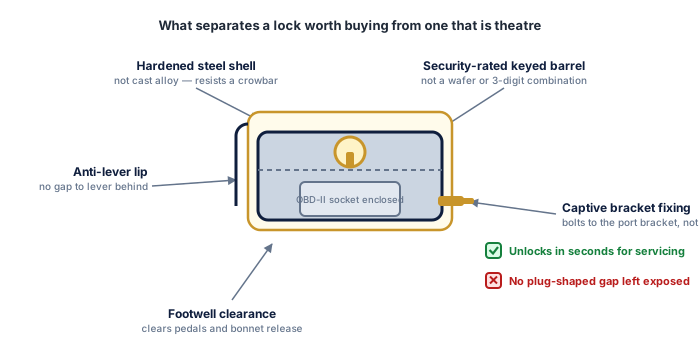
- ✓Hardened steel case with a security-rated lock — the point is resisting a crowbar in the dark
- ✓Model-specific fit beats universal where available — check your OBD port location first
- ✓Keyed versions beat combination in the dark footwell
- ✓Your garage will need access at services — keep the key with the service book
- ✓Pairs naturally with a Faraday pouch: block the unlock AND the key-programming
Ad — we earn commission on the links below. When you buy through them we receive a commission from the retailer, at no extra cost to you. It changes nothing about what appears here: the checklist above is written first and the links are added afterwards.
Which one should you buy?
Four things get sold as an “OBD lock” and they are not equivalent. Colour-coded by what we would actually recommend.
 Best choice for most
Universal steel port case
£20–£35
A hardened shell that clamps around the socket and locks with a key. It is the option most owners should buy: cheap, fits most footwells, no wiring, and it defeats the plug-in attack outright.
Best for: Almost everyone. Buy this first unless your footwell is unusually tight.
See current options →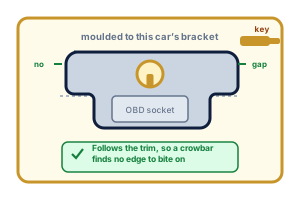 Worth the extra
Model-specific case
£30–£50
Same idea, but moulded for one car's bracket and clearances. Tighter fit means less leverage for a crowbar and no fouling of the bonnet release.
Best for: Owners of frequently targeted models where a specific version exists.
See current options →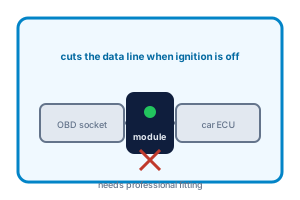 Situational
Electronic immobiliser-linked lock
£60–£200 fitted
Wired in line, it cuts the data connection whenever the ignition is off, so a programmer plugged in receives nothing. Invisible, and nothing to unlock at services. Needs professional fitting.
Best for: Higher-value cars, or where a bulky case will not fit.
See current options →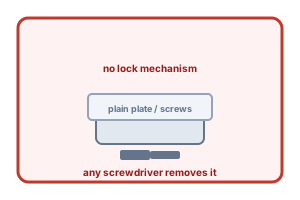 We would not
Blanking plate or DIY screws
under £15
A cover with no lock. Any screwdriver removes it, and self-tapping screws into the socket face risk damaging the pins your garage needs. Widely suggested on forums; it buys confidence rather than time.
Best for: Nothing we would recommend. Listed so you can recognise it.
Links open a search rather than one listing, because stock and prices change daily. Compare whatever you find against the checklist above.
What changes once you own it
The port thieves rely on for key-cloning is sealed behind steel. With relay blocked at home and OBD blocked in the cabin, the two dominant electronic theft routes are both closed for around £50 — and your car quietly leaves the 'easy' category that police data shows thieves work through street by street.
Asked before buying
Will it affect servicing or MOTs?
No — you simply unlock it when the garage needs diagnostic access, like handing over a locking wheel-nut key. Keep the key with your service paperwork.
Which cars need this most?
High-volume models with cheap circulating programmers benefit most — and our MOT and theft-context pages can tell you how targeted your model's segment is. If your car is keyless, treat pouch + port lock as one product in two pieces.
Isn't the immobiliser enough?
The OBD attack works *through* the immobiliser system — it registers a new key as legitimate. That's precisely why physically blocking the port matters.
Do OBD port locks really work?
For the attack they are designed to stop, yes. Key-cloning through the diagnostic socket needs physical access to that socket, and a steel case removes it. What they do not do is stop entry, relay unlocking or towing, which is why they are usually fitted alongside a Faraday pouch and a visible steering lock.
Can an OBD port lock be bypassed?
Given enough time and the right tool, yes — a determined crew can lever or cut a case, and specialists sometimes carry removal tools for common models. Bypassing takes minutes of conspicuous work in a footwell, which is exactly the friction that makes a thief choose a different car.
Can I leave something plugged into my OBD2 port?
Insurance dongles and trackers can normally stay plugged in, though anything left connected draws a small current and can contribute to a flat battery on a car used infrequently. If you use a dongle, choose a lock or relocation option that accommodates it rather than one that seals the socket completely.
Where is the OBD port on my car?
Within reach of the driver's seat by law, usually in the footwell under or beside the steering column, occasionally behind a trim panel or near the fusebox. Check yours before ordering, because port position determines whether a universal case will physically fit.
Will an OBD lock affect my MOT, warranty or servicing?
No. The lock does not modify the vehicle's wiring or emissions systems, and testers see them routinely — you simply unlock it for diagnostic access. Electronic versions should be professionally fitted so no fault codes or parasitic draw are introduced.
Which cars are most targeted for OBD key cloning?
High-volume models with widely circulating programmers, which in the UK has included popular Ford, Toyota, Hyundai and Kia models among others. Ownership forums for your specific model are the fastest way to learn whether local thefts are happening and which method is being used.
Are OBD port locks worth it?
For a keyless car on a driveway, yes as one layer: around £25 against a theft that costs you an excess, your insurance record and weeks without a vehicle. They are not worth it as your only measure, and not worth it at all if you buy the type with no lock mechanism. If you have not yet bought a Faraday pouch, buy that first.
What is the best OBD port lock?
For most owners, a hardened steel case with a keyed barrel that clamps around the socket body, in a model-specific version if one exists for your car. Machined aluminium and steel cases from established security brands cost £25–£50; code-operated trade units and electronic immobiliser-linked systems run from about £60 to £120 fitted. Avoid anything that is only a cover with no lock.
What if I lose the OBD lock key?
Order a replacement from the manufacturer against the code card supplied with the lock, which is why that card should live with your service book rather than in the car. Without it, removal usually means drilling or cutting the barrel, which a locksmith or garage can do but which destroys the lock. Buy a second key with the lock if one is offered.
Will fitting an OBD lock affect my warranty?
A clamp-on case that changes no wiring should not, but check with your manufacturer or dealer before fitting anything that is wired in, and keep documentation of a professional installation. Some makers actively suggest physical port protection; others take a dim view of anything spliced into the vehicle network.
Where can I buy an OBD port lock in the UK?
Online marketplaces carry universal cases from around £20; specialist vehicle security firms sell code-operated and electronic versions from about £60 to £120, usually with fitting. Motor factors and larger high-street car parts shops stock them intermittently, so it is worth checking availability before travelling.
How this page is funded. Some links here go to Amazon, and as an Amazon Associate we earn commission from qualifying purchases, at no extra cost to you. It changes nothing about what we recommend: the checklist above is written first, the links are added afterwards, and we hold no stock of this product and take no payment for placement. Where a product does not deserve a recommendation, we say so.
Where this fits
A modern car theft is three actions in sequence. Each defence blocks one of them.
Almost every guide to car security lists products. Almost none explain that a keyless theft happens in a fixed order, that each defence interrupts one specific step, and that blocking one step does nothing about the others. That is why people buy a signal-blocking pouch, feel protected, and are still stolen from — the pouch stops the first step and the thief simply starts at the second.
- 1
How does a thief get into a locked car without breaking anything?
They relay the signal from your key through the wall of your house. One person stands near the front door with an amplifier, another at the car with a repeater, and the car believes the key is in the driver's hand. A signal-blocking pouch ends this: sealed inside, the fob cannot transmit, so there is nothing to relay.
But it only protects the key. Once a thief is inside the car by any other means — a broken window, a spare key, a door left unlocked — the pouch is irrelevant.
- 2
So how do I make sure the pouch is actually used, every night?
By removing the decision. A lined box by the front door holds every key in the house and gets used because it sits where keys already land. Same shielding, no discipline required — which matters, because the usual cause of a relay theft in a household that owns a pouch is a night the pouch was not used.
But shielding the key is still only the first step. It does nothing once a thief is inside the car by another route.
- 3
They are inside the car. How do they start it without the key?
They plug a key programmer into the diagnostic socket in the driver's footwell and write a blank fob to the vehicle. The car then starts normally, which is why so many stolen cars show no damage at all. A steel case locked over that socket removes the connection point, and the attack fails before it starts.
But a lock on the port does not stop the car being taken on a flatbed, and it does not help if the thief already has a working key.
You are reading this step
- 4
What stops the car moving even if they defeat the electronics?
A mechanical lock across the wheel, which no electronic attack touches. It works twice over: the car cannot be steered, and — more importantly — it is visible through the windscreen before anyone approaches, which moves your car down the list on a street of easier targets.
Next in the sequence: Steering wheel lock
But a lock on the port does not stop the car being taken on a flatbed, and it does not help if the thief already has a working key.
See the whole sequence on one page · We could not find a single UK page that sets out the sequence and matches a defence to each stage. Retailers sell one product at a time and have no reason to tell you it is incomplete.
Related on Swift Assist
Vehicle crime in your town
Police-recorded crime around 100+ UK town centres, updated monthly — see the risk this defends against.
Read more →Faraday key pouch / box
Relay theft is the fastest-growing way cars are stolen in Britain — and it is completely defeated by a signal-blocking pouch on your hallway table. The catch nobody mentions: pouches wear out silently, so we show you how to check yours still works.
Read more →Steering wheel lock
A visible, Sold Secure-rated bar turns a 60-second theft into a noisy, tool-heavy job — so the thief moves on.
Read more →Need this data for your own work?
Site and junction reports from £95, next working day. Free for community groups, campaigners and journalists.