Four alloys can come off a parked car in minutes. £25 of locking nuts keeps them on.
Wheel theft leaves cars on bricks and owners with a four-figure bill. One keyed nut per wheel removes your car from the shopping list.
Locking wheel nuts: the short version
By Stephen Hall, Data lead, Swift AssistLocking wheel nuts replace one nut on each wheel with a nut that has a unique pattern instead of a standard hexagon. Only the matching key socket turns it, so a thief with ordinary tools cannot remove the wheel, and alloys stay on the car.
- The real problem
- This is a records problem more than a hardware one. Most people lose the key, not the wheels.
- Do this now, free
- Photograph the key code and store it in the cloud, so the code survives the key
- Where the code lives
- Varies by manufacturer — a card in the handbook, a sticker, stamped on the box, or held against the VIN
- What it stops
- Wheel removal with the tools a thief is already carrying
- Typical price
- £20–£40 for a set; £40–£150 to have a seized or keyless nut removed
What actually happens
Alloy wheels are cash on legs: desirable sets fetch hundreds used, they carry no serial numbers, and a practised pair with a trolley jack and battery gun can strip all four in under ten minutes. Victims find the car on bricks — wheels gone, sills damaged, undriveable — with a bill that runs from £800 to well past £2,000 on premium sets, plus the recovery truck.
Like most vehicle crime in our data, it's a selection game played street by street: thieves scout for target wheels, and a car without locking nuts is a car that can be stripped in silence with standard tools.
Background: the theft and collision patterns above draw on our own analysis of official records — explore the vehicle crime data and methodology.
How does locking wheel nuts work?
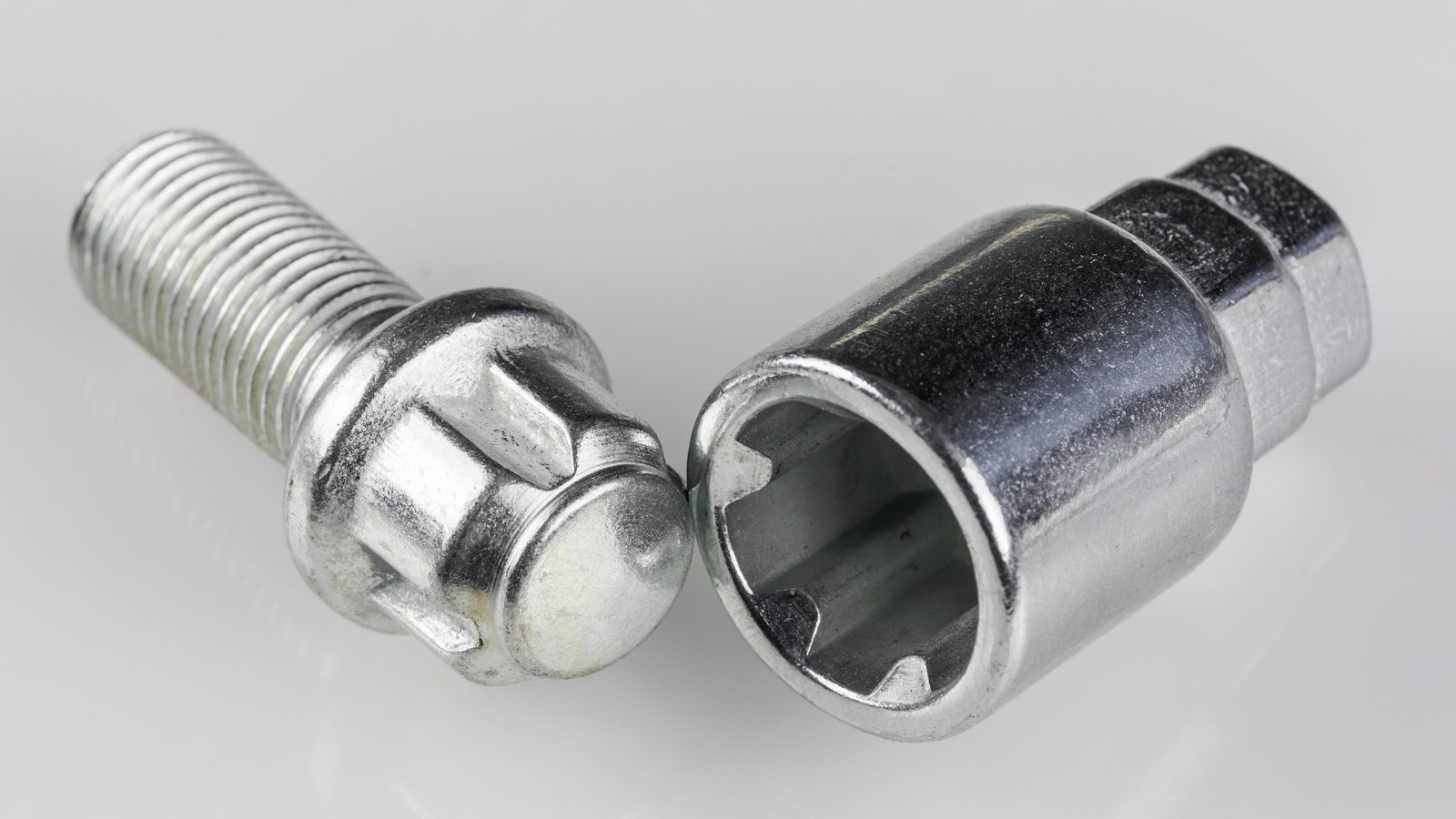
Locking wheel nuts replace one nut on each wheel with a nut that has a unique pattern instead of a standard hexagon. Only the matching key socket turns it, so a thief with ordinary tools cannot remove the wheel, and alloys stay on the car.
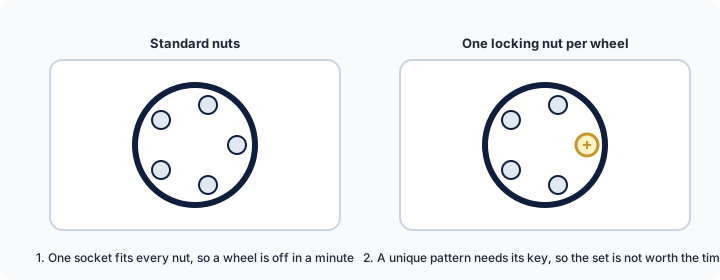
- 1How wheels are stolenA practised pair with a trolley jack and a battery impact gun can strip four wheels in well under ten minutes. The car is left on bricks, the sills are usually damaged, and the bill runs from around £800 to well past £2,000 on premium alloys.
- 2What the locking nut changesEach locking nut has a keyed pattern — splines, grooves or an off-centre profile — that a standard socket cannot grip. Without the key, the wheel cannot be removed with the tools a thief is carrying.
- 3Why quality mattersCheap locking nuts use a handful of common patterns, and grip sockets hammer straight on and wind them off. Better sets use unique patterns and a free-spinning collar that the removal tool cannot bite into.
- 4Keep the key findableStore the key with your spare wheel or service book, never loose in the glovebox where a thief will check first, and keep the code card so a replacement key can be ordered.
Nut types and removal kits, compared
The pattern on the nut decides both how hard it is for a thief and how hard it will be for your garage. That second consequence is the one nobody mentions until you have lost the key.
| Type | How it works | Typical cost | Servicing | Watch out for |
|---|---|---|---|---|
| Splined or grooved nut | A unique internal pattern needing a matching key socket | £20–£40 | Keep the key with the spare wheel | Cheap patterns repeat across sets; grip sockets defeat them |
| Free-spinning collar nut | An outer ring that rotates freely so a socket cannot bite | £30–£50 | As above | Genuinely harder to defeat — and genuinely harder for a garage to remove if you lose the key |
| Factory-fitted set | Supplied with the car | Included | Find the code card today | The code card is the part that goes missing, usually in the first change of ownership |
| Removal kit | Hardened extractor sockets hammered onto the nut | £15–£40 | n/a | Frequently slips or rounds the nut on free-spinning designs, and can damage the alloy |
How to install one
- 1Find the code card before you need itIt may be a card in the handbook wallet, a sticker inside the storage case, stamped on the key itself, or recorded by the dealer against the VIN. Not every manufacturer records it against the VIN, which is exactly why finding it now matters.
- 2Photograph the code and store it where you will find itCloud storage, or emailed to yourself. This one step converts a £40–£150 problem into a five-minute one, and it costs nothing.
- 3Torque them properlyTo the manufacturer's figure with a torque wrench. Over-tightened locking nuts are the commonest reason a key shears, and a sheared key on a locking nut is a considerably worse afternoon than a lost one.
- 4Do not keep the key in the gloveboxIt is the first place searched, and a thief who finds the key has the wheels. Keep it with the spare wheel or in the house.
- 5Check the spare fits tooIf your spare or space-saver needs a standard nut, make sure you can still fit it at the roadside with what is in the car.
What it does not do
Most pages about this product only tell you the good part. These are the objections raised by owners and locksmiths, and they are fair ones.
They buy time, not immunity
A determined thief with extractor sockets and a few minutes will get a wheel off. The point is that the tools already in the van are not enough, and that is usually the whole calculation.
Cheap sets repeat their patterns
A handful of common patterns circulate across budget sets, and matching sockets are sold openly. Unique patterning is most of what you are paying for above about £30.
The security cuts both ways
The thing that stops a thief also stops your garage, the tyre fitter and the roadside patrol. Free-spinning collars in particular can turn a puncture into a recovery.
Nobody checks whether you have them
Insurers may ask, and alloy cover can be conditional, but this is settled at claim time rather than checked in advance. Read your own policy wording rather than assuming.
What to buy — the checklist
- ✓One locking nut per wheel minimum, keyed to a unique pattern — the key stays with you, not in the car
- ✓Choose a reputable branded set (McGard-style) — cheap sets have common patterns thieves carry keys for
- ✓Correct thread size and seat type for your car — check the handbook (e.g. M12x1.5, taper seat)
- ✓Spinning-collar designs resist the grip-socket removal tools that defeat basic locking nuts
- ✓Keep the key code card somewhere safe at home — you'll need it if the key is ever lost
Ad — we earn commission on the links below. When you buy through them we receive a commission from the retailer, at no extra cost to you. It changes nothing about what appears here: the checklist above is written first and the links are added afterwards.
Where to start looking
Branded unique-pattern set
Spinning-collar design that defeats grip-socket removal tools.
~£30 · See options →
Check your thread first
Match thread and seat to your handbook before ordering.
~£25 · See options →
Searches, not endorsements of a single listing — compare whatever you find against the checklist above.
What changes once you own it
Stripping your wheels now needs a specialist removal tool, more time, and more noise than the identical unprotected car nearby — so it doesn't happen. Your alloys stay on, your excess stays unspent, and the whole defence costs less than a single tyre. Fit them once and forget them: this is the closest thing vehicle security has to a free win.
Asked before buying
Can thieves remove locking wheel nuts?
Basic ones, yes — grip sockets hammer onto cheap locking nuts and wind them off. Quality spinning-collar designs defeat that tool, which is why the branded set is worth the extra £15. No nut is absolute; the job is making removal slow, loud and not worth it.
My car came with locking nuts — do I need better ones?
Factory sets are often low-security common patterns. If your wheels are desirable (AMG, M Sport, RS and similar), upgrading to a unique-pattern branded set is a meaningful step up for £30.
What if I lose the key?
Keep the code card from the box — manufacturers supply replacement keys against it. A garage can also remove locking nuts destructively if needed. Never leave the key in the glovebox: thieves check there first.
I've lost my locking wheel nut key — what do I do?
In order of cost: find the code card, which may be in the handbook wallet, on a sticker inside the storage case, or stamped on the key box, and order a replacement key from a manufacturer or specialist. If there is no code, a dealer may be able to look it up against the VIN — though not every manufacturer records it that way, which is the part people discover too late. Failing both, a mobile specialist or garage can extract the nut, typically for somewhere between £40 and £150 depending on the design and how seized it is.
Where is the code for my locking wheel nuts?
It varies by manufacturer and there is no single answer, which is why this catches so many people. Look for a plastic card in the handbook wallet, a sticker inside the plastic storage case, a number stamped on the key itself or on the box, and check the service book. If you find it, photograph it today and store the picture in the cloud — that single step converts a £40 to £150 problem into a five-minute one.
Can I just use a removal kit from a motor factor?
Sometimes. Hardened extractor sockets hammered onto the nut work reasonably on older splined patterns. They frequently slip or round the nut on modern designs with a free-spinning outer collar, and a slipped socket can damage the alloy you were trying to protect. If the nut has a rotating outer ring, this is a job worth paying somebody to do properly.
Are locking wheel nuts even necessary any more?
Alloy wheel theft has not gone away — it takes minutes with a trolley jack and an impact gun, the car is usually left damaged, and a set of premium alloys runs well into four figures. Insurers may also ask, and alloy cover is sometimes conditional on having them. They are not a strong deterrent on their own; they mean the tools already in the van are not enough, which is usually enough.
Where should I keep the key?
Not in the glovebox, which is the first place a thief looks and where most people keep it. With the spare wheel is better; in the house is better still, provided you will actually remember it exists when you have a puncture. Keep the code separately from the key, because losing both at once is the expensive scenario.
How this page is funded. Some links here go to Amazon, and as an Amazon Associate we earn commission from qualifying purchases, at no extra cost to you. It changes nothing about what we recommend: the checklist above is written first, the links are added afterwards, and we hold no stock of this product and take no payment for placement. Where a product does not deserve a recommendation, we say so.
Where this fits
Prevention can fail. What decides whether you see it again is what was fitted beforehand.
Recovery is the part nobody plans for and the part where the honest answer is uncomfortable: most stolen vehicles are not recovered, and the measures that help are the ones fitted before anything happened. This sets out what genuinely assists a recovery, what only assists an identification afterwards, and where the popular answer is weaker than people assume.
- 1
Can I just find it myself with a cheap tracker?
Partly, and it depends far more on where you hide it than which one you buy. A consumer tracker has no GPS and no SIM — it reports through passing phones — so it needs a signal that escapes the vehicle. That rules out the sealed metal cavities that feel like the best hiding places. Behind interior trim beats the back of the glovebox, because thieves check compartments and rarely strip interiors.
But a location is not a recovery. Police will not usually act on a ping alone without a crime reference, and if the tracker is found you have nothing.
- 2
If the parts are stripped and sold, is there any route back to me?
Marking gives one, and the deterrent works through the warning label rather than the chemistry. A thief choosing between two vehicles has a reason to pick the unmarked one. Where a marked part is later examined, the code traces to you. What the marketing skips is that nothing about a sale or a scrapping triggers an automatic check — no dealer is obliged to look.
And marking does nothing to make a part harder to remove in the first place.
- 3
What if they only want the wheels?
Wheels are stolen far more often than whole cars and take minutes with a trolley jack and an impact gun. Locking nuts do not make removal impossible; they mean the tools already in the van are not enough, which is usually the whole calculation.
You are reading this step
See the whole sequence on one page · Consumer tracking advice is written almost entirely by people selling subscriptions, and marking is sold with claims about checks that do not happen. We answer both straight, including where the answer is no.
Related on Swift Assist
Vehicle crime in your town
Police-recorded crime around 100+ UK town centres, updated monthly — see the risk this defends against.
Read more →Catalytic converter lock
Cat theft targets the rhodium and palladium inside — hybrids worst of all. A bolted guard turns a two-minute cut into a job thieves abandon.
Read more →Steering wheel lock
A visible, Sold Secure-rated bar turns a 60-second theft into a noisy, tool-heavy job — so the thief moves on.
Read more →Need this data for your own work?
Site and junction reports from £95, next working day. Free for community groups, campaigners and journalists.