A tracker only helps if the thief does not find it. That is a question about where, not which.
Where a hidden tracker actually survives a search, and why the best hiding places are not the hardest to reach.
Tracker concealment mount: the short version
By Stephen Hall, Data lead, Swift Assist · reviewed 2026-09-05A concealment mount holds a consumer tracker such as an AirTag somewhere hidden in a vehicle, securely enough that it does not move and positioned so its signal can still get out. The difficulty is that the best-hidden places are usually enclosed in metal, and metal blocks the signal the tracker depends on.
- What it is
- A mount or case that holds a consumer tracker out of sight and stops it moving
- The real problem
- Signal and concealment pull in opposite directions
- What it will not do
- Recover the vehicle by itself, or replace a crime reference number
- Typical price
- £8–£25 for the mount
- Fitting
- Minutes, no tools on most mounts
What actually happens
Most advice on hiding a tracker is a list of places, with no explanation of which ones survive a thief who is looking.
The obvious hiding places — glovebox, boot floor, under a seat — are the first three a thief checks, and metal enclosures kill the signal anyway.
A tracker that cannot report its position is the same as no tracker, and you will not find out until the day it matters.
Background: the theft and collision patterns above draw on our own analysis of official records — explore the vehicle crime data and methodology.
How does a tracker concealment mount work?
A concealment mount holds a consumer tracker such as an AirTag somewhere hidden in a vehicle, securely enough that it does not move and positioned so its signal can still get out. The difficulty is that the best-hidden places are usually enclosed in metal, and metal blocks the signal the tracker depends on.
- 1How a consumer tracker actually reportsAn AirTag has no GPS and no SIM. It emits a short-range Bluetooth signal that is picked up by passing phones, which relay the location. So it needs two things: a signal that escapes the vehicle, and other people nearby. In a busy area that is constant; on a remote industrial estate it may be hours.
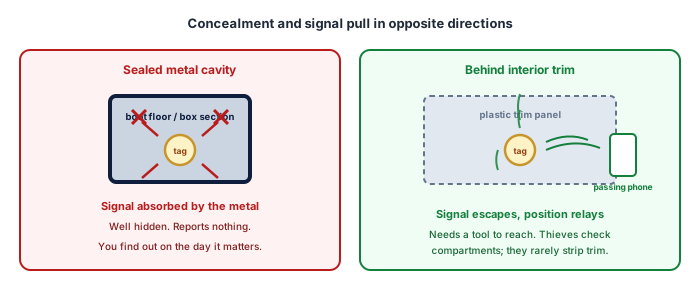
- 2Why metal is the whole problemA sealed metal cavity is a Faraday cage. A tracker in a boot floor well, inside a steel box section or under a metal seat pan can be effectively silent. The hiding places that feel most secure are frequently the ones that stop it working.
- 3What a thief actually searchesSomeone stealing a vehicle to order works quickly and checks the known spots: glovebox, centre console, boot floor, under seats, the OBD area. The good locations are not the hardest to reach — they are the ones nobody bothers to strip. Behind trim that requires tools is better than deep inside somewhere obvious.
- 4Test it from a distanceFit it, walk two streets away, and check it still reports. Then check again the next day. A tracker that only reports when you are standing next to the car is telling you the position is wrong.
Where a tracker can actually go, compared
Each of these trades concealment against signal, and the sealed metal options that feel most secure are frequently the ones that stop the tracker working at all.
| Type | How it works | Typical cost | Servicing | Watch out for |
|---|---|---|---|---|
| Adhesive or magnetic mount | Holds the tracker against a panel out of sight | £8–£15 | Check adhesive annually | Magnets on a steel panel put the tracker against metal, which hurts the signal |
| Weatherproof case, external | Sealed case mounted underneath or in a wheel arch | £12–£25 | Inspect for water ingress | Road salt and pressure washing. Also more exposed to being found. |
| Trim-cavity mount, internal | Sits behind a panel that needs tools to remove | £10–£20 | Access needs the panel off | Best signal-to-concealment balance in most cars, but plan the battery change |
| Thatcham-approved tracker | GPS and SIM, professionally fitted, monitored | £250–£700 plus subscription | Annual subscription | A different product entirely. Monitored recovery is what insurers recognise. |
How to install one
- 1Rule out sealed metal firstBefore choosing a spot, ask whether it is enclosed by metal on most sides. Boot floor wells, steel box sections and under metal seat pans are the common mistakes.
- 2Prefer behind trim to deep in the obviousA panel that needs a trim tool to remove is better than the back of a glovebox. Thieves check compartments; they rarely dismantle interiors.
- 3Fix it so it cannot moveA tracker rolling around a cavity will be heard, and will eventually end up somewhere useless. The mount is doing this job, not the adhesive strip that came in the box.
- 4Note the battery dateConsumer trackers run roughly a year. Put the change date in a calendar with a note of where it is, because in twelve months you will not remember.
- 5Test at distance, twiceTwo streets away on day one, and again on day two. Position problems show up as intermittent reporting, not total silence.
What it does not do
Most pages about this product only tell you the good part. These are the objections raised by owners and locksmiths, and they are fair ones.
It does not get the vehicle back
A location is not a recovery. Police will not usually act on a tracker ping alone without a crime reference number and, in practice, some corroboration. Do not go and confront anyone; the value of the tracker is evidence, not retrieval.
Consumer trackers can be detected
Both major phone platforms alert people to unknown trackers moving with them. That is a deliberate anti-stalking feature and it works, which means a determined thief may well be told your tracker is present.
It depends on other people's phones
A Bluetooth tracker reports through passing devices. In a city that is near-continuous. In a rural yard or a shipping container it may report nothing for a long time.
One tracker is a single point of failure
If the one you fitted is found, you have nothing. Two, in genuinely different types of location, is a more realistic setup than one perfect hiding place.
What to buy — the checklist
- ✓Somewhere the signal can escape: away from large flat metal, not inside a sealed metal cavity
- ✓Somewhere a thief will not strip, rather than somewhere merely awkward to reach
- ✓Secure enough not to move on a motorway, which rules out loose placement
- ✓Removable by you without tools, because batteries need changing
- ✓Checked from a distance after fitting, not assumed
Ad — we earn commission on the links below. When you buy through them we receive a commission from the retailer, at no extra cost to you. It changes nothing about what appears here: the checklist above is written first and the links are added afterwards.
What changes once you own it
The tracker keeps reporting after the vehicle has been taken, and keeps reporting long enough to matter — because it is somewhere that both transmits and survives a search.
Asked before buying
Where is the best place to hide an AirTag in a car?
Somewhere the signal can escape and a thief will not strip. In practice that means behind interior trim that needs a tool to remove, rather than inside a compartment. Avoid anywhere enclosed by metal on several sides — boot floor wells, steel box sections, under metal seat pans — because those block the Bluetooth signal the tracker relies on. Fix it so it cannot move, and test from two streets away before trusting it.
Will an AirTag actually help me get my car back?
It can help, but it does not do the recovering. It gives you a location to give the police alongside a crime reference number. Officers will not usually act on a ping alone, and you should not go to the location yourself. Treat it as evidence rather than retrieval.
Can a thief detect it?
Possibly. Both major phone platforms warn people when an unknown tracker travels with them, which is an anti-stalking protection working as designed. A thief carrying a phone may be alerted, which is an argument for fitting two trackers in different kinds of place rather than relying on one.
Is a consumer tracker as good as a proper vehicle tracker?
No, and they are not the same product. A Thatcham-approved tracker has its own GPS and mobile connection and a monitored service that liaises with police. A consumer tracker costs a fraction of that and depends on passing phones. The cheap one is worth having; it is not a substitute.
Does hiding it under the car work?
Sometimes, in a weatherproof case. The signal is usually better than inside a metal cavity, but the location is exposed to road salt, water and being spotted. If you use it, treat it as the second tracker rather than the only one.
How this page is funded. Some links here go to Amazon, and as an Amazon Associate we earn commission from qualifying purchases, at no extra cost to you. It changes nothing about what we recommend: the checklist above is written first, the links are added afterwards, and we hold no stock of this product and take no payment for placement. Where a product does not deserve a recommendation, we say so.
Where this fits
Prevention can fail. What decides whether you see it again is what was fitted beforehand.
Recovery is the part nobody plans for and the part where the honest answer is uncomfortable: most stolen vehicles are not recovered, and the measures that help are the ones fitted before anything happened. This sets out what genuinely assists a recovery, what only assists an identification afterwards, and where the popular answer is weaker than people assume.
- 1
Can I just find it myself with a cheap tracker?
Partly, and it depends far more on where you hide it than which one you buy. A consumer tracker has no GPS and no SIM — it reports through passing phones — so it needs a signal that escapes the vehicle. That rules out the sealed metal cavities that feel like the best hiding places. Behind interior trim beats the back of the glovebox, because thieves check compartments and rarely strip interiors.
But a location is not a recovery. Police will not usually act on a ping alone without a crime reference, and if the tracker is found you have nothing.
You are reading this step
- 2
If the parts are stripped and sold, is there any route back to me?
Marking gives one, and the deterrent works through the warning label rather than the chemistry. A thief choosing between two vehicles has a reason to pick the unmarked one. Where a marked part is later examined, the code traces to you. What the marketing skips is that nothing about a sale or a scrapping triggers an automatic check — no dealer is obliged to look.
And marking does nothing to make a part harder to remove in the first place.
- 3
What if they only want the wheels?
Wheels are stolen far more often than whole cars and take minutes with a trolley jack and an impact gun. Locking nuts do not make removal impossible; they mean the tools already in the van are not enough, which is usually the whole calculation.
Next in the sequence: Forensic marking kit
But a location is not a recovery. Police will not usually act on a ping alone without a crime reference, and if the tracker is found you have nothing.
See the whole sequence on one page · Consumer tracking advice is written almost entirely by people selling subscriptions, and marking is sold with claims about checks that do not happen. We answer both straight, including where the answer is no.
Related on Swift Assist
Vehicle crime in your town
Police-recorded crime around 100+ UK town centres, updated monthly — see the risk this defends against.
Read more →GPS tracker (Thatcham-approved)
Deterrents lower the odds; a Thatcham-approved tracker changes the outcome when the odds lose.
Read more →Faraday key pouch / box
Relay theft is the fastest-growing way cars are stolen in Britain — and it is completely defeated by a signal-blocking pouch on your hallway table. The catch nobody mentions: pouches wear out silently, so we show you how to check yours still works.
Read more →Need this data for your own work?
Site and junction reports from £95, next working day. Free for community groups, campaigners and journalists.