After a crash it's your word against theirs. Footage ends the argument.
A dashcam with parking mode is a witness that never blinks — for collisions, car-park hits and theft attempts alike.
What actually happens
Disputes about who did what are where honest drivers lose. When it is one account against another, a collision that wasn't your fault can still be recorded as shared blame — costing your excess, your insurance record and years of higher premiums. The difference between a clear account and a messy split is almost always evidence.
Parked cars have it worse: car-park dents, clipped mirrors and vandalism happen to an empty witness stand — unless the camera was rolling.
Background: the theft and collision patterns above draw on our own analysis of official records — explore the vehicle crime data and methodology.
How does a dashcam work?
A dashcam continuously records the road ahead in a loop, overwriting old footage and locking clips when its motion sensor detects an impact. With parking mode and a hardwire kit it keeps watching while the car is unattended, so both collisions and car park damage are recorded with a timestamp.
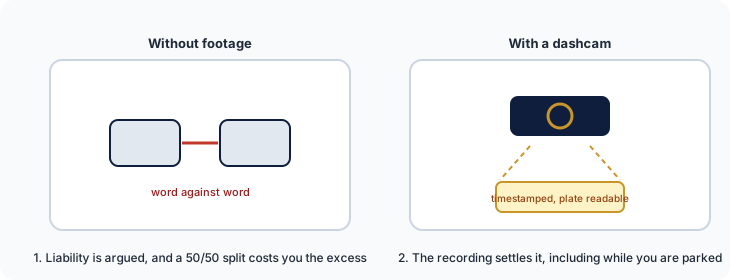
- 1Loop recordingThe camera writes short clips to a memory card and deletes the oldest as it fills, so it can run indefinitely without you managing storage.
- 2Impact lockingA g-sensor detects a sudden jolt and moves the current clip to a protected folder so it cannot be overwritten. That is what preserves the thirty seconds either side of a collision, which is the part that decides liability.
- 3Parking modeWired to a permanent live feed through a hardwire kit, the camera stays in a low-power state and wakes on motion or impact. Voltage cut-off protection in the kit stops recording before your battery drops too low to start the car.
- 4Why it settles disputesInsurers and courts accept dashcam footage routinely. Provide the original file with its timestamp intact and do not edit it: a readable registration plate and a clear sequence of events turns a 50/50 argument into a documented account.
What to buy — the checklist
- ✓Parking mode with hardwire kit or battery pack — the parked hours are half the value
- ✓1440p or better: you need plates readable at distance, not just shapes
- ✓Front-and-rear kit if you can — rear-end disputes are the most common of all
- ✓Loop recording with impact-lock so crucial clips can't be overwritten
- ✓Check footage access is painless (app transfer) — evidence you can't retrieve isn't evidence
Ad — we earn commission on the links below. When you buy through them we receive a commission from the retailer, at no extra cost to you. It changes nothing about what appears here: the checklist above is written first and the links are added afterwards.
Where to start looking
Enthusiast value: Viofo A119 V3
1440p HDR and proper buffered parking mode — the spec-per-pound favourite.
~£110 · See options →
Our pick: Nextbase 322GW front + rear
Rear-end incidents are among the most commonly disputed, and this claims — cover both ends, in the format insurers see daily.
~£180 · See options →
Searches, not endorsements of a single listing — compare whatever you find against the checklist above. Want named picks ranked by attack rating? Best dashcams UK (2026) for insurance evidence: parking mode ranked.
What changes once you own it
Every dispute becomes checkable. 'Sorry mate, I didn't see you' meets a timestamped recording; the car-park dent comes with a registration plate attached; and if the incident is ever disputed, your evidence is already gathered before you've left the scene. Among everything on these pages, this is the one that pays for itself in a single incident.
Asked before buying
Is dashcam footage actually accepted as evidence?
Insurers and courts routinely accept it, and it is frequently decisive where accounts of an incident conflict. Provide the original file with its timestamp and don't edit anything.
Does parking mode flatten the battery?
A proper hardwire kit includes voltage cut-off protection that stops recording before your battery drops too low to start. Cheap setups without it are how the myth started.
Front-only or front-and-rear?
Rear-end and reversing incidents are among the most commonly disputed, so rear coverage earns its cost quickly. If the budget only stretches to one, front-facing still covers the majority of dispute scenarios.
How this page is funded. Some links here go to Amazon, and as an Amazon Associate we earn commission from qualifying purchases, at no extra cost to you. It changes nothing about what we recommend: the checklist above is written first, the links are added afterwards, and we hold no stock of this product and take no payment for placement. Where a product does not deserve a recommendation, we say so.
Related on Swift Assist
Vehicle crime in your town
Police-recorded crime around 100+ UK town centres, updated monthly — see the risk this defends against.
Read more →Faraday key pouch / box
Relay theft is the fastest-growing way cars are stolen in Britain — and it is completely defeated by a signal-blocking pouch on your hallway table. The catch nobody mentions: pouches wear out silently, so we show you how to check yours still works.
Read more →Steering wheel lock
A visible, Sold Secure-rated bar turns a 60-second theft into a noisy, tool-heavy job — so the thief moves on.
Read more →Need this data for your own work?
Site and junction reports from £95, next working day. Free for community groups, campaigners and journalists.