Diamond, Gold, Silver — the rating everyone quotes and almost nobody explains.
What the Sold Secure grades actually test, why a Gold for bicycles is not a Gold for motorcycles, and which one your insurer means.
Sold Secure bike lock: the short version
By Stephen Hall, Data lead, Swift Assist · reviewed 2026-09-05Sold Secure is an independent testing house that attacks security products with the tools thieves actually use and awards a grade based on how long the product resists. The grades run Bronze, Silver, Gold and Diamond. Crucially the tests are category-specific, so a lock rated Gold for bicycles has not passed the motorcycle Gold test, which is more demanding.
- What Sold Secure is
- An independent UK testing house that attack-tests security products
- The grades
- Bronze, Silver, Gold and Diamond, in ascending order of attack resistance
- The trap
- Grades are category-specific. A bicycle Gold and a motorcycle Gold are different tests.
- Typical price
- £30–£150 depending on grade
- Why weight matters
- Resistance to power tools comes largely from hardened material and thickness
What actually happens
Insurers require a rating without explaining it, so people buy the wrong grade and find out at the worst moment.
The same word means different things in different categories, and the packaging does not make that obvious.
A lock is only as good as what it is locked to, which no product page discusses.
Background: the theft and collision patterns above draw on our own analysis of official records — explore the rider data and methodology.
How does a Sold Secure rated bike lock work?
Sold Secure is an independent testing house that attacks security products with the tools thieves actually use and awards a grade based on how long the product resists. The grades run Bronze, Silver, Gold and Diamond. Crucially the tests are category-specific, so a lock rated Gold for bicycles has not passed the motorcycle Gold test, which is more demanding.
- 1What the test involvesTrained testers attack the product with a defined toolkit within a time limit. Higher grades face longer attacks and more capable tools. The grade describes resistance to a realistic attack, not an absolute guarantee.
- 2Why the category matters more than the colourSold Secure rates within categories — bicycle, motorcycle, powered cycle and others — and the thresholds differ. A motorcycle Gold is a harder test than a bicycle Gold. Reading only the word on the box is how people end up under-locked and, if it comes to a claim, outside the terms of their policy.
- 3What an insurer is actually asking forPolicies commonly specify a grade and a category. If yours says Sold Secure Gold for a motorcycle, a bicycle Gold does not satisfy it. Check the wording rather than the marketing, because this is settled at claim time and not before.
- 4The angle grinder problemA cordless angle grinder will eventually get through nearly anything portable. Higher grades and newer grinder-resistant designs extend that time, and time in a public place is the actual deterrent. Nothing here is proof against unlimited, unobserved attack.
Lock types, compared
Weight is the honest trade-off here: resistance to a power tool comes largely from hardened material and thickness, so the lock that resists longest is the one you are least likely to carry.
| Type | How it works | Typical cost | Servicing | Watch out for |
|---|---|---|---|---|
| D-lock / U-lock | Hardened shackle, compact | £30–£120 | Lubricate the barrel annually | Fill the space inside the shackle — slack lets a jack or bar in |
| Chain and padlock | Hardened chain, sleeved | £50–£150 | Keep the sleeve intact | Heavy. Never leave it lying on the ground. |
| Folding lock | Hinged hardened plates | £40–£100 | Check rivets | Convenient, generally rated lower than an equivalent D-lock |
| Grinder-resistant D-lock | Materials that shed or bind a cutting disc | £100–£200 | As a normal D-lock | Genuinely raises attack time. Heavy and expensive. |
How to install one
- 1Read your policy wording firstFind the grade AND the category your insurer requires before buying. This is the step that decides whether the lock is fit for purpose.
- 2Lock frame to anchor, not wheel to framePass the lock through the frame and around something immovable. A wheel locked to a frame leaves the bike portable.
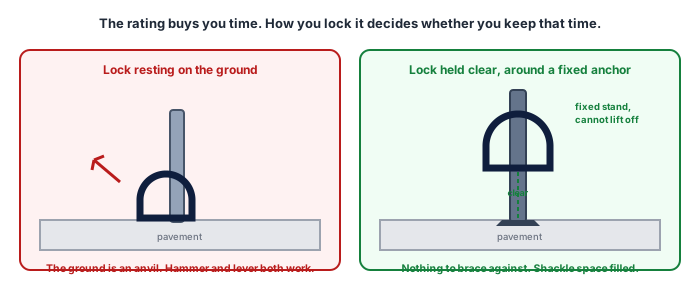
- 3Fill the shackleMinimise the empty space inside a D-lock. Slack space is where a bottle jack or a lever goes.
- 4Keep it clear of the groundLock high enough that the lock body hangs free. Ground contact gives a thief leverage and an anvil.
- 5Two locks of different types beats one expensive oneA D-lock and a cable, or a D-lock and a chain, need two toolsets. Most opportunist thieves carry one.
What it does not do
Most pages about this product only tell you the good part. These are the objections raised by owners and locksmiths, and they are fair ones.
A rating is a time, not a guarantee
Every grade describes how long a defined attack took. Given enough time, no noise concerns and no passers-by, a determined thief with a grinder gets through. The grade buys minutes, and minutes are what makes a thief move on.
The anchor decides the outcome
A Diamond lock around a sign post that lifts out of its socket protects nothing. What the bike is locked to matters as much as the lock, and is the part almost never discussed.
Off the ground, always
A lock resting on the pavement gives a thief a solid surface to hammer or lever against. Locking so the lock hangs clear removes that advantage and costs nothing.
Grades are reviewed
Sold Secure updates its tests as attack methods change. A rating from years ago was awarded under the standards of its time.
What to buy — the checklist
- ✓The grade your insurer specifies, in the category that matches your vehicle
- ✓Rated for bicycles if it is a bicycle — motorcycle grades are a different test
- ✓Heavy enough to resist an angle grinder for a meaningful time, which means accepting weight
- ✓Long enough to reach a solid anchor point, not just the frame
- ✓Kept off the ground, so a thief cannot use the pavement as an anvil
Ad — we earn commission on the links below. When you buy through them we receive a commission from the retailer, at no extra cost to you. It changes nothing about what appears here: the checklist above is written first and the links are added afterwards.
What changes once you own it
You hold the grade your policy actually requires, you understand what it was tested against, and the lock is used in a way that does not undo the rating you paid for.
Asked before buying
Is Powered Cycle Gold the same as Pedal Cycle Diamond?
Yes, and this is the single most useful thing to know about these ratings. Sold Secure states that Powered Cycle Gold and Pedal Cycle Diamond offer the same level of security, tested with the same tools, the same attack methods and the same time limits. The Powered Cycle specification only has two grades, Diamond and Gold. So the real ladder is Powered Cycle Diamond, then Powered Cycle Gold and Pedal Cycle Diamond level with each other, then Pedal Cycle Gold, then Silver and Bronze. A lock badged simply 'Sold Secure Gold' could be the second rung or the fourth, and the listing usually omits the word that tells you which.
What is the difference between Sold Secure Gold and Diamond?
Diamond is tested against a longer and more determined attack than Gold, with a more capable toolkit. Both are meaningful; Diamond is the highest grade and is what higher-value insurance policies increasingly specify. The grade describes how long the product resisted, not that it cannot be defeated.
Does a Gold rated bicycle lock meet a motorcycle Gold requirement?
No. Sold Secure rates within categories and the thresholds differ, with motorcycle tests more demanding than bicycle ones. If your policy specifies a motorcycle grade, a bicycle-rated lock of the same colour does not satisfy it. Check the category on the certificate, not just the word.
Will any lock stop an angle grinder?
Not indefinitely. A cordless grinder will eventually cut nearly anything portable, which is why the grades describe time. Grinder-resistant designs extend that time significantly, and time in a visible place is what makes a thief leave. Treat any claim of grinder-proof as marketing.
What should I lock my bike to?
Something fixed, solid, and that the lock cannot be lifted over. Purpose-built stands are best. Sign posts often lift out of their sockets, and railings are frequently easier to cut than your lock. The anchor is as important as the lock and gets a fraction of the attention.
Is an expensive lock worth it for a cheap bike?
Match the lock to what a replacement costs and where it is kept. A £30 rated lock on a £300 bike used in a low-theft area is sensible. If you are leaving anything in a city centre overnight, the honest advice is that no portable lock is enough on its own.
How this page is funded. Some links here go to Amazon, and as an Amazon Associate we earn commission from qualifying purchases, at no extra cost to you. It changes nothing about what we recommend: the checklist above is written first, the links are added afterwards, and we hold no stock of this product and take no payment for placement. Where a product does not deserve a recommendation, we say so.
Where this fits
On a bike the two risks arrive together — being hit because nobody saw you, and losing it while it is parked.
The collision records show how much of the harm in each area happens in darkness, and how much of that happens where there is no street lighting at all. That second figure is the one that decides whether reflective material is enough on its own. Theft is the other half of the same trip: most riders lose more nights to worrying about where the bike is parked than to the ride itself.
- 1
Why does being seen after dark come down to more than dark clothing?
Retroreflective material returns light to its source, so a driver's headlights pick it up at roughly three times the distance of dark fabric — at 30mph that is most of the stopping distance. It is the cheapest intervention available and the one with the largest effect per pound.
But reflection needs a light already aimed at you. On an unlit road, or approaching a junction from the side, there may not be one — which is what the dark-and-unlit share for your area is telling you.
- 2
It is parked. What rating do I actually need?
The grade your insurer specifies, in the category that matches your vehicle. Sold Secure attack-tests within categories, and the thresholds differ — a motorcycle Gold is a harder test than a bicycle Gold. Reading only the colour on the box is how people end up under-locked and, at claim time, outside their policy terms.
And a rating is a time, not a guarantee. What the bike is locked to matters as much as the lock, and the lock should never rest on the ground.
You are reading this step
- 3
What stops it being wheeled away while I am not there?
A disc lock immobilises the wheel, and the alarmed version adds noise at the moment of interference — which matters because most opportunist theft depends on nobody looking. The rule every rider learns the hard way is that the reminder cable is not optional: riding off with a disc lock fitted is how forks get bent.
Next in the sequence: Alarmed disc lock
And a rating is a time, not a guarantee. What the bike is locked to matters as much as the lock, and the lock should never rest on the ground.
See the whole sequence on one page · Visibility advice is usually a slogan rather than an explanation, and lock ratings are quoted without anyone explaining that a Gold for bicycles and a Gold for motorcycles are different tests.
Related on Swift Assist
The rider danger map
Where motorcyclists are hurt in Britain, from five years of official DfT records.
Read more →Chain & ground anchor
A Sold Secure Diamond chain through the frame into a concrete-bolted anchor is the difference between a theft and an abandoned attempt.
Read more →Alarmed disc lock
A pocket-sized lock that pins the brake disc and screams the moment the bike moves — the rider's first, best £30.
Read more →Need this data for your own work?
Site and junction reports from £95, next working day. Free for community groups, campaigners and journalists.